
| August 11, 2026 | Desk: Brand & IP Law | 19 min read · 4343 words |
Pakistan is an agricultural economy. Agriculture contributes approximately 20 percent of GDP, employs nearly 40 percent of the labour force, and underpins the rural economy of most of the country. The sector produces wheat, rice, cotton, sugarcane, fruits, vegetables, oilseeds, and livestock products at enormous scale, and it is supported by a large and commercially active agri-input industry supplying seeds, Fertilizers, pesticides, irrigation equipment, and veterinary products to millions of farming households.
In this vast agricultural economy, brand names matter enormously. A farmer choosing between seed varieties, Fertilizer brands, or pesticide products is making decisions that directly affect crop yield, input cost, and livelihood. Brand trust in agricultural inputs is not an abstract commercial consideration. It is a practical production decision made by people whose incomes depend on getting it right.
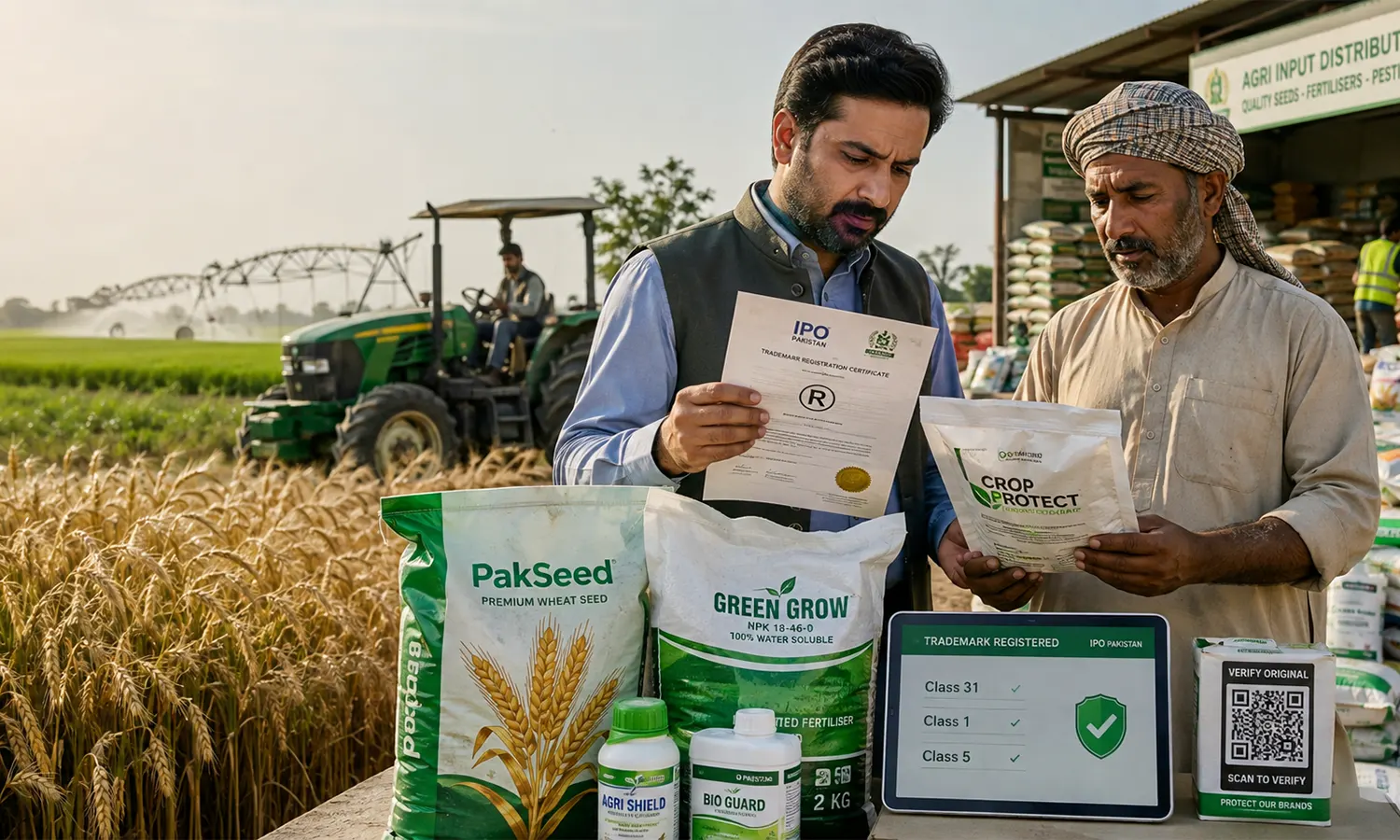
Yet across most agricultural brand categories, trademark protection awareness in Pakistan is lower than in almost any other commercial sector. Seed brands operate without trademark registration. Fertilizer brands are built over decades without trademark protection. Pesticide companies invest in regulatory approvals from the Department of Plant Protection while neglecting the parallel and entirely separate trademark registration process. And the intersection between plant variety protection, pesticide registration, Fertilizer approval, and trademark law is widely misunderstood.
Nice Classes for Agricultural Brands
| Class | What It Covers in Agriculture | File When |
| Class 31 | Seeds, fresh agricultural produce, grains, live plants, fresh fruits and vegetables, live animals, animal feed | Always for seed brands, fresh produce brands, agricultural goods |
| Class 1 | Fertilizers, soil conditioners, agricultural chemicals, chemical preparations for plant cultivation | Always for Fertilizer manufacturers and agricultural chemical brands |
| Class 5 | Pesticides, herbicides, fungicides, insecticides, veterinary medicines, animal health products | Always for pesticide and veterinary product brands |
| Class 7 | Agricultural machinery, tractors, harvesting equipment, irrigation pumps, farm implements | Farm equipment manufacturers, importers, and distributors |
| Class 11 | Irrigation systems, drip irrigation equipment, water management apparatus, agricultural water pumps | Irrigation equipment brands and water management companies |
| Class 29 | Processed animal and vegetable products, preserved fruits, dairy products, processed agricultural foods | Agri-food brands processing animal and vegetable produce |
| Class 30 | Cereal products, packaged rice, flour, spices, condiments, grain-based processed food products | Rice mills, flour brands, spice brands, packaged grain brands |
| Class 35 | Agricultural trading and distribution services, commodity trading, agri-input distribution | Agricultural traders, distributors, agri-input retail chains |
The Regulatory and Trademark Dual-Framework Problem in Agriculture
The agricultural sector presents the same dual-framework problem that appears in fintech, healthcare, and media: the regulatory approval and the trademark registration are entirely separate processes, each administered by a different government body, and having one does not provide the other.
Pesticide registration with the Department of Plant Protection gives a pesticide formulation the right to be sold as an approved product in Pakistan. It does not give the brand name protection. A competitor who manufactures the same or a similar pesticide formulation under a different registration but with the same or a confusingly similar trade name is not prevented from doing so by the DPP registration of the original registrant. Only a trademark registration in Class 5 at IPO Pakistan provides that protection.
The same applies to Fertilizer approvals and veterinary medicine registrations. The approval of a Fertilizer formulation does not protect the brand name under which the Fertilizer is marketed. A competitor can produce a Fertilizer with the same nutrient composition and market it under the same brand name if the original brand has not registered that name as a trademark.
| 💡 The Core Principle: Regulatory Approval ≠ Trademark Protection |
| This distinction applies across every regulated sector in Pakistan, and agriculture is no exception: DPP pesticide registration = right to sell the approved formulation. Does NOT protect the brand name. Fertilizer approval = right to sell the approved formulation. Does NOT protect the brand name. Veterinary medicine registration = right to sell the approved product. Does NOT protect the brand name. Trademark registration at IPO Pakistan = exclusive right to use the brand name in commerce. Required separately in addition to all regulatory approvals. Both are necessary. Neither substitutes for the other. |
Plant Variety Protection and Trademark: Understanding the Relationship
Pakistan has a plant variety protection framework under the Plant Breeders’ Rights Ordinance 2000, which provides intellectual property protection for new plant varieties that are distinct, uniform, stable, and novel. Plant variety protection protects the variety itself — the genetic and phenotypic characteristics of a specifically bred plant variety — rather than the name under which it is marketed.
Trademark law and plant variety protection law are distinct and complementary systems. A plant breeder who has developed a new variety can obtain plant breeder’s rights protection for the variety itself and trademark protection for the name under which the variety is marketed. Plant breeder’s rights protect the breeder’s exclusive right to produce, sell, and license propagating material of the protected variety. They expire after a defined period and are subject to research exemptions and farmers’ privilege exceptions.
Trademark protection for the variety name protects the commercial brand identity under which the variety is marketed. A seed sold under a distinctive branded name creates consumer recognition in that name that is worth protecting independently of the plant variety protection for the underlying variety. When the plant breeder’s rights expire, the trademark protection for the brand name continues to protect the commercial identity from being copied by competitors.
For seed companies and plant breeders, the correct approach is to pursue both plant variety protection for new varieties that qualify and trademark registration for the commercial names under which those varieties are marketed. The two protections are complementary and reinforce each other.
Counterfeit Seeds and Brand Protection
Counterfeit seeds are one of the most commercially and agriculturally damaging forms of trademark infringement in Pakistan’s agricultural sector. A farmer who purchases counterfeit seeds sold under the name of a trusted seed brand is paying for a product that may not germinate at the expected rate, may not produce the expected yield, and may not have the disease resistance or climate adaptation characteristics that the genuine brand’s product is known for.
The commercial damage to the genuine seed brand from counterfeit seed sales is multi-dimensional. The immediate commercial loss is the sale diverted to the counterfeit seller. The reputational damage arises when farmers who have purchased counterfeit seeds, believing they are the genuine product, experience poor crop performance and attribute it to the genuine brand. The agricultural damage extends to the farmers themselves, whose livelihoods are affected by the crop failure that counterfeit seeds cause.
Trademark registration in Class 31 is the foundation of enforcement action against counterfeit seed producers and distributors. A seed brand that holds a registered trademark in Class 31 can pursue civil infringement proceedings, criminal enforcement under the counterfeit goods provisions of the Trade Marks Ordinance, and customs recordal to intercept counterfeit seed imports at the border. Without the trademark registration, each of these enforcement mechanisms is significantly harder to activate.
Agri-Food Brands and Geographical Indications
Pakistan’s agri-food processing sector creates brand identities that sit at the intersection of commercial trademark law and geographical indication protection. Pakistani agricultural products with distinctive regional characteristics — Basmati rice, Sindhri mangoes, Chaunsa mangoes — are candidates for geographical indication protection that would restrict use of the geographic name to products from the defined area meeting specified standards.
For agri-food brands that process and market these geographically distinctive products, the trademark strategy needs to be coordinated with the geographical indication framework. A branded rice company that markets Basmati rice under its own brand name has trademark interests in its own brand name and product packaging that are separate from and in addition to any geographical indication protection for the Basmati designation itself.
The practical advice for agri-food brands dealing with geographically distinctive products is to register the own brand name as a trademark in the appropriate goods classes while staying informed about the geographical indication status of the geographic designation that describes the underlying product. Developments in the EU’s geographical indication framework for products like Basmati rice can have significant commercial implications for agri-food brands that export those products.
| ⚠ Real-World Example: The Pesticide Brand and the Copycat Product |
| A Pakistani pesticide company had been marketing a herbicide under a distinctive brand name for twelve years, building strong recognition among farmers and retailers in Punjab’s rice-growing regions. The company held a valid DPP registration for the herbicide formulation but had never registered the brand name as a trademark. A competing pesticide company began marketing a herbicide under a name that was a minor phonetic variation of the established brand’s name, with similar packaging colours and presentation. Agricultural retailers reported that farmers frequently confused the two products, sometimes purchasing the competing product believing they were buying the established brand. Without a trademark registration, the primary remedy was passing-off proceedings, requiring months of evidence gathering before a claim could be filed. The evidence included sales records, retailer testimonies documenting confusion, and market research showing brand association. The company simultaneously filed a trademark application in Class 5 at IPO Pakistan. When the trademark was eventually registered, the enforcement position became significantly stronger. The lesson: the DPP registration and the trademark registration serve entirely different purposes. The trademark application should be filed alongside or before the DPP registration, not twelve years after it. |
| ⚠ Real-World Example: The Seed Brand and the Counterfeit Network |
| A reputable Pakistani seed company with a registered trademark in Class 31 had built a nationally recognised brand among Punjab wheat farmers. During the wheat planting season, field representatives identified bags of seed in multiple district markets that used the company’s brand name, logo, and packaging design but were clearly not produced by the company — counterfeit seeds priced approximately 15 percent below the genuine product. Because the company held a registered trademark in Class 31, it was able to take coordinated enforcement action. Civil infringement proceedings were commenced against identified distributors. Law enforcement was engaged under the criminal counterfeiting provisions of the Trade Marks Ordinance. The company’s registered trademark with Pakistan Customs enabled border enforcement action against imported counterfeit seeds. The civil proceedings resulted in injunctions against the identified distributors and damages awards. The criminal enforcement action resulted in seizure of significant quantities of counterfeit seed and prosecution of the persons responsible. The company’s field representatives subsequently incorporated counterfeit monitoring into their regular market visits, treating it as an ongoing operational discipline rather than a one-time response. This case illustrates that a registered trademark in Class 31 enables a complete enforcement toolkit — civil, criminal, and customs — that is significantly harder to activate without registration. |
Step-by-Step: Building Trademark Protection for Pakistani Agricultural Brands
Step 1: Identify All Commercial Brand Elements Across the Agricultural Business
An agricultural business may use multiple distinct names: a corporate brand, product brand names for specific varieties or formulations, sub-brands for different product lines, and distribution channel names. Identify each name used commercially, map it to the agricultural activities it covers, and assess which names have sufficient commercial significance to warrant separate trademark protection.
Step 2: Determine the Correct Nice Classes
Map the business’s commercial activities to Nice Classes. Class 31 for seeds, fresh produce, and agricultural goods. Class 1 for Fertilizers and agricultural chemicals. Class 5 for pesticides, herbicides, and veterinary products. Class 7 for agricultural machinery and equipment. Classes 29 and 30 for processed food products. Class 35 for trading and distribution services. Multiple classes will often be relevant for a single agricultural business.
Step 3: File the Trademark Application Simultaneously with Regulatory Approvals
The regulatory approval process and the trademark registration process should be initiated simultaneously, not sequentially. The time required to obtain a DPP registration for a pesticide or an approval for a Fertilizer formulation is time during which a trademark application could also be progressing through IPO Pakistan’s examination process. Filing the trademark application at the same time as the regulatory approval process begins is the most efficient use of the parallel timelines.
Step 4: Register with Pakistan Customs for Anti-Counterfeiting Protection
For seed brands, Fertilizer brands, and pesticide brands that face counterfeit product risks, register the trademark with Pakistan Customs under the intellectual property recordal mechanism. This enables customs officials to intercept counterfeit agricultural inputs at the border without needing a court order for each shipment. Counterfeit agricultural inputs frequently enter Pakistan through informal import channels, and border enforcement through customs recordal can prevent large volumes of counterfeit products from reaching the farm-level market.
Step 5: Build Market Monitoring into Field Operations
Agricultural brands that have field sales representatives visiting farming communities, retailers, and wholesale markets have a natural monitoring capability that consumer goods brands typically lack. Build counterfeit product monitoring into the standard activities of field representatives: ask retailers about unfamiliar products using similar brand names, photograph any suspected counterfeit products, and report findings systematically. This field-level monitoring can identify counterfeit operations early, before they reach significant scale.
Step 6: Coordinate Trademark and Plant Variety Protection Strategies
For seed companies and plant breeders, coordinate the trademark protection strategy for product names with the plant variety protection strategy for protected varieties. Use both forms of intellectual property protection where both are available: plant breeder’s rights for the variety itself and trademark protection for the commercial name under which the variety is marketed. The two protections reinforce each other and together provide more comprehensive protection than either alone.
Common Mistakes Pakistani Agricultural Brands Make with Trademarks
Assuming DPP or Fertilizer Approval Registration Protects the Brand Name
This is the most common and most commercially costly mistake in Pakistan’s agricultural brand protection landscape. The Department of Plant Protection registration for a pesticide, the Fertilizer approval, and the veterinary medicine registration all relate to the right to sell the approved formulation. None of them protects the brand name. Trademark registration at IPO Pakistan is a separate process that provides brand name protection, needed in addition to, not instead of, the relevant regulatory approval.
Filing Only in One Class and Missing Adjacent Agricultural Activities
An agricultural chemicals company that registers in Class 1 for Fertilizers but also markets pesticides without registering in Class 5 has a protection gap. A seed company that registers in Class 31 for seeds but also markets packaged processed grain products without registering in Class 30 has left the processed products unprotected. The multi-class nature of most agricultural businesses means that a comprehensive trademark strategy typically requires registrations across multiple classes.
Neglecting Trademark Protection for Crop-Specific Product Sub-Brands
Many agricultural companies market different products under crop-specific or use-specific sub-brand names — a specific herbicide for wheat, a specific fungicide for cotton, a specific seed treatment for rice — without registering these sub-brand names separately from the corporate brand. Sub-brand names that have built independent market recognition are worth protecting as separate trademark registrations.
Not Acting Promptly Against Counterfeit Agricultural Products
Agricultural brands that discover counterfeit products in the market sometimes delay enforcement action during peak planting or harvest seasons when management is focused on commercial operations. Counterfeit agricultural products that are allowed to remain in the market during peak seasons cause the maximum damage: farmers make planting decisions based on counterfeit products during the window when their purchasing decisions are concentrated. Prompt enforcement is essential.
Frequently Asked Questions
Can a Seed Company Register the Name of a Specific Plant Variety as a Trademark?
Yes, but with an important limitation. A variety name that is distinctive and used commercially to identify the seed product of a specific company can be registered as a trademark in Class 31. However, variety names that have been officially designated as the denomination of a registered plant variety under the plant variety protection framework may be required to remain available as the variety name. The relationship between trademark protection and official variety denomination is a specific legal question that seed companies should address with professional advice.
Does Trademark Registration in Pakistan Protect Agricultural Product Names in Export Markets?
No. Trademark registration at IPO Pakistan provides protection within Pakistan. Agricultural product names in export markets need separate trademark protection in those markets. For Pakistani agricultural exporters, the Madrid Protocol provides the most cost-effective mechanism for extending Pakistani trademark protection to multiple international markets simultaneously. For agri-food brands exporting to the European Union, understanding the EU’s geographical indication framework alongside the trademark framework is important, particularly for products like Basmati rice that have or may have geographical indication status in that market.
Can Two Different Pesticide Companies Use the Same Brand Name If They Have Different DPP Registrations?
No. A pesticide brand name is a commercial identifier that functions in the marketplace independently of the DPP registration. Two pesticide companies with different DPP registrations cannot both legitimately use the same brand name in commerce without one of them infringing the other’s trademark rights, assuming one of them has a trademark registration. If neither has a trademark registration, the first to use the name commercially may have passing-off rights, but the legal position is significantly less clear than where one party has a trademark registration.
What Is the Relationship Between Plant Breeder’s Rights and Trademark Protection for Seed Brands?
Plant breeder’s rights protect the variety itself — the genetic and phenotypic characteristics of a specifically bred plant variety — giving the breeder exclusive rights to produce and sell propagating material of the variety for a defined period. Trademark protection for the variety name protects the commercial brand identity under which the variety is marketed, independently and without a defined expiry period. Both protections can coexist and reinforce each other. Plant breeder’s rights are administered under the Plant Breeders’ Rights Ordinance 2000; trademark rights are administered under the Trade Marks Ordinance 2001.
How Should a Fertilizer Brand Handle a Competitor Using a Confusingly Similar Name?
If the Fertilizer brand holds a registered trademark in Class 1, it should file a trademark infringement complaint. The first step is typically a cease and desist letter supported by the trademark registration certificate, formally demanding that the competitor cease using the confusingly similar name. If the competitor does not comply, civil trademark infringement proceedings can be commenced in the relevant court. Where the confusion has resulted in commercial damage, damages can be claimed alongside injunctive relief.
Final Thoughts
Pakistan’s agricultural sector is vast, commercially significant, and increasingly brand-driven. The farmer who chooses a specific seed brand, the retailer who stocks a specific Fertilizer brand, and the export buyer who sources a specific agri-food brand are all making decisions based on brand trust built through years of product quality, commercial reliability, and market presence.
Protecting that brand trust through trademark registration is as important in agriculture as in any other commercial sector, and in some respects more important: counterfeit agricultural inputs cause direct agricultural harm to farmers whose livelihoods depend on getting their input decisions right.
Register in the right classes. File the trademark application alongside the regulatory approval, not years after it. Build counterfeit monitoring into field operations. And treat the trademark portfolio as the commercial asset it is — one that protects both the business and the farmers who depend on genuine, quality-assured agricultural products.
| Get Started with TM |
| TM helps Pakistani agricultural businesses, seed companies, Fertilizer brands, pesticide manufacturers, farm equipment brands, and agri-food processors register and protect their trademarks at IPO Pakistan and internationally. Visit: tm.com.pk/contact Email: contact@tm.com.pk Phone: 03-111-456-456 |