
| August 24, 2026 | Desk: Brand & IP Law | 16 min read · 3668 words |
Pakistan’s logistics and courier sector has undergone a fundamental commercial transformation in the past five years. The explosive growth of e-commerce, the formalisation of previously informal delivery networks, the entry of international logistics brands into the Pakistani market, and the emergence of technology-driven last-mile delivery platforms have created a sector that is simultaneously more competitive, more brand-driven, and more commercially significant than at any point in Pakistan’s commercial history.
TCS, Leopards, M&P, BlueEX, Trax, and PostEx are competing nationally for e-commerce logistics market share. Daewoo Express and Faisal Movers have built nationally recognised intercity identities. DHL, FedEx, and UPS operate in Pakistan’s corporate courier market. New entrants offering hyperlocal delivery, cold chain logistics, and specialised freight services are building brand identities in niche segments. And the integration of logistics with e-commerce platforms has created new brand relationships where the delivery brand is as visible to the end consumer as the seller brand.
This commercial sophistication has produced a trademark landscape that is increasingly contested. Established brands risk imitation from newer entrants with similar names. International brands entering the Pakistani market face squatters who have pre-registered their names. Logistics startups building technology-driven platforms invest heavily in brand development without securing trademark registration. And the specific Nice Classes that apply — primarily Class 39 for transport and delivery services — are widely misunderstood among Pakistani logistics entrepreneurs.
Nice Classes for Logistics and Courier Brands
| Class | What It Covers in Logistics | File When |
| Class 39 | Courier services, parcel delivery, freight forwarding, warehousing, storage, transport, shipment tracking, moving and relocation services | Always — foundational class for every logistics and courier brand |
| Class 9 | Logistics tracking apps, shipment management software, delivery management platforms, mobile courier applications | Any brand with a logistics technology platform or app |
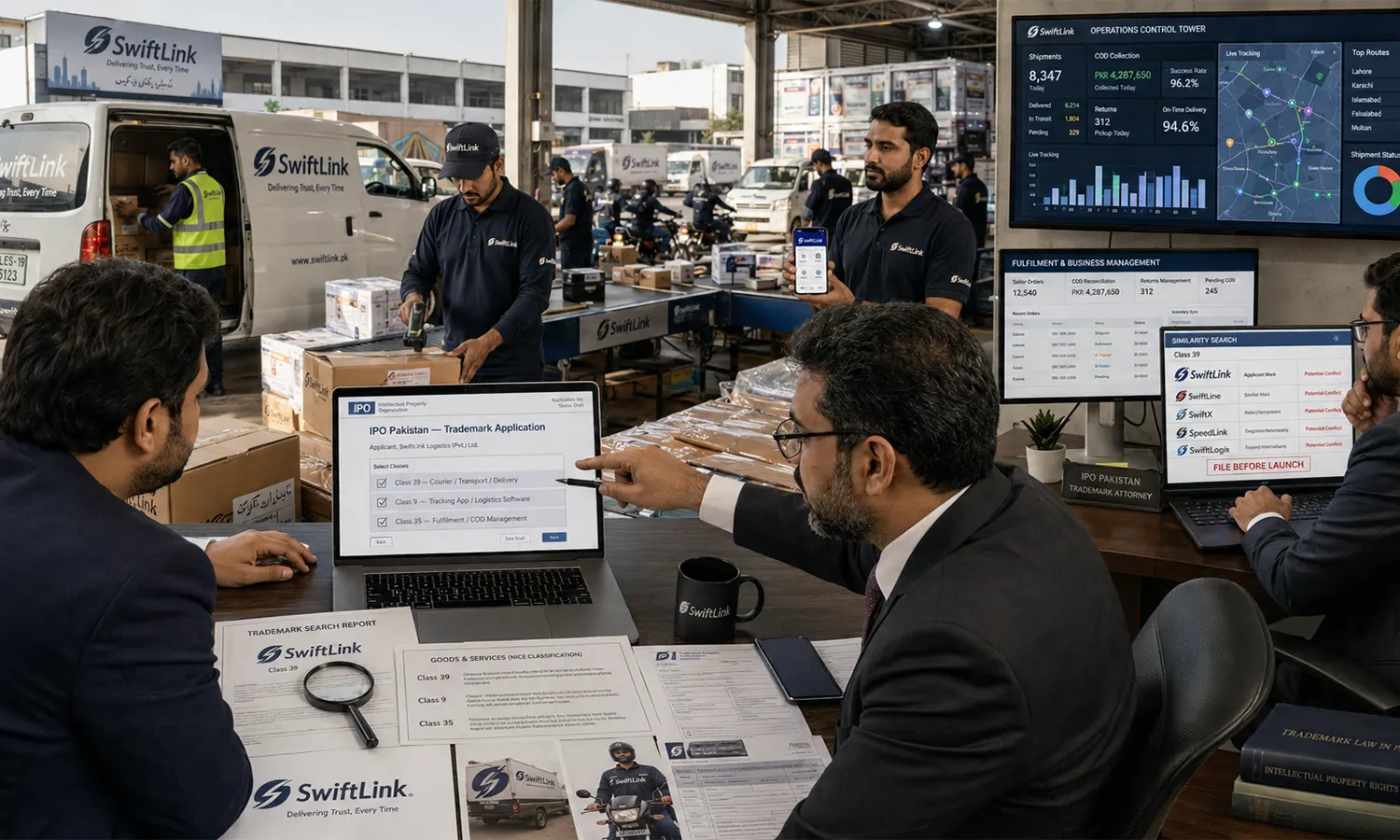
| Class 35 | Fulfilment services, cash-on-delivery management, returns processing, seller dashboard services, logistics administration | E-commerce logistics brands with fulfilment management services |
| Class 36 | Cash-on-delivery collection and remittance, working capital advances against collections, logistics financial services | COD-heavy e-commerce logistics brands with financial service dimensions |
| Class 16 | Branded packaging materials, courier envelopes, shipping labels, branded packing supplies | Brands with distinctive branded packaging as a commercial product |
| 💡 The Three-Class Core for Modern Pakistani Logistics Brands |
| Most Pakistani logistics brands need more than just Class 39. The competitive advantage of a modern e-commerce logistics brand is often as much in its technology and financial services capabilities as in its physical delivery network. Trademark protection must reflect where the commercial value actually resides: Class 39 — the physical delivery and transport services. Class 9 — the tracking app, logistics platform, and management software. Class 35 — the COD management, returns processing, and fulfilment services. File all three simultaneously. The cost difference between one class and three is modest. The protection gap of omitting Class 9 or Class 35 in a technology-driven logistics business is not. |
The Structure of Pakistan’s Logistics Brand Landscape
National Courier Brands
TCS, Leopards Courier, M&P Logistics, BlueEX, and others have built strong recognition in their respective market segments. These brands compete on reliability, coverage, and tracking technology, and their brand names are the primary basis on which customers and businesses choose between them. For established national courier brands, monitoring the market for new entrants with confusingly similar names is an ongoing commercial priority.
E-Commerce Logistics Specialists
PostEx, Trax, and similar brands have built specific value propositions around the requirements of e-commerce sellers — cash-on-delivery management, returns processing, integration with Daraz and other platforms, and same-day or next-day delivery commitments. The brand identities of these specialists are built not just on delivery reliability but on their specific technological and financial service capabilities. These brands need trademark protection across Class 39, Class 9, and Class 35.
Intercity Transport Brands
Daewoo Express, Faisal Movers, Bilal Travels, and others carry both passengers and cargo and have built nationally recognised brand identities through decades of consistent service. The cargo and logistics dimensions of their operations make trademark protection in Class 39 relevant alongside any other class registrations they hold.
International Courier Brands and Their Pakistani Footprint
DHL, FedEx, UPS, and Aramex operate in Pakistan’s corporate and international courier market. These brands hold their trademark registrations internationally and typically in Pakistan as well. Their presence in the market creates the specific risk of Pakistani businesses operating under confusingly similar names. International courier brands actively monitor for infringing uses of their names in all markets where they operate, including Pakistan. A Pakistani logistics startup that chooses a name phonetically or visually similar to an international courier brand faces infringement exposure from the moment of launch.
Last-Mile, Hyperlocal, and Cold Chain Brands
Bykea Delivery, Rider, and similar platforms are building brand identities in the urban last-mile delivery space, integrating logistics with ride-hailing infrastructure. Cold chain and specialised logistics brands are an emerging category as Pakistan’s food processing, pharmaceutical, and perishable goods export sectors develop specialised logistics requirements. Each of these brand categories has distinct trademark considerations that include the technology platform dimension alongside the physical delivery service.
The Specific Trademark Risks in Pakistan’s Logistics Sector
Name Confusion in a Crowded Market
Pakistan’s courier market has become increasingly crowded, with multiple competitors operating under names that are phonetically or visually similar. A market with national brands called TCS, MCS, LCS, and similar combinations creates genuine consumer confusion risk. A new logistics startup that launches under a name confusingly similar to an established brand — whether through ignorance of the existing brand or through deliberate proximity strategy — creates trademark exposure from the moment of launch and a rebranding liability that compounds with every month of commercial activity under the infringing name.
International Brand Squatting
The entry of international logistics brands into the Pakistani market has been complicated, in multiple cases, by prior trademark registrations at IPO Pakistan by Pakistani businesses operating under the international brand’s name or a closely similar version. An international logistics brand that has not registered its name in Pakistan before becoming commercially known in Pakistan through its international reputation faces the specific risk that its brand name has already been registered by a squatter or by a Pakistani business that began using the name without awareness of the international brand. The Madrid Protocol provides a streamlined mechanism for international brands to designate Pakistan as part of a broader international trademark registration.
E-Commerce Platform Integration Risks
E-commerce logistics brands that integrate closely with e-commerce platforms face specific brand risks related to the platform integration context. A logistics brand whose name and logo appear within an e-commerce platform interface needs trademark protection that covers the commercial context in which the brand name appears to buyers and sellers. The integration of logistics brands with e-commerce platform ecosystems also creates risks of brand confusion at the point of sale, where a buyer may not distinguish between the e-commerce platform’s branded logistics and the independent logistics brand’s services.
| ⚠ Real-World Example: The Courier Brand and the Similar Name Entrant |
| A Pakistani courier company with a well-established brand name and a Class 39 trademark registration discovered that a new courier startup had launched in Lahore under a brand name that was a single-syllable difference from the established brand, operating in the same e-commerce seller market and using a colour scheme visually similar to the established brand’s identity. The established brand’s customer service team began receiving complaints from e-commerce sellers who had engaged the new entrant believing they were dealing with the established brand. The new entrant’s tracking portal was also receiving enquiries meant for the established brand. The established brand’s legal team sent a cease and desist letter based on the Class 39 trademark registration, documenting the confusingly similar name, the similar visual identity, and the documented instances of customer confusion. The new entrant disputed the similarity. Trademark infringement proceedings were commenced. The court found in favour of the established brand, granting an injunction requiring the new entrant to rebrand within sixty days. From cease and desist letter to court order took approximately four months — efficient precisely because the established brand held a clear, registered trademark in the relevant class. |
| ⚠ Real-World Example: The E-Commerce Logistics Platform and the Missing Class 9 Registration |
| An e-commerce logistics startup had built a branded platform providing sellers with shipment booking, COD management, returns processing, and a real-time tracking dashboard through a distinctive branded mobile application. The brand had registered its name as a trademark in Class 39 for logistics and courier services — but not in Class 9. A competing platform launched under a confusingly similar brand name with a mobile application that closely resembled the established startup’s application in user interface, colour scheme, and dashboard design. The startup’s Class 39 trademark registration supported a complaint about the confusingly similar brand name. But because the startup had not registered in Class 9 for the software application, the infringement claim relating to the application specifically was limited. The startup also filed a copyright claim on the visual design elements, but copyright enforcement against application design is more complex and less certain than trademark enforcement. The startup subsequently registered in Class 9 and Class 35. The lesson: an e-commerce logistics platform whose competitive advantage is as much in its technology and financial services as in its physical delivery network needs trademark protection across Class 39, Class 9, and Class 35 — not Class 39 alone. |
Step-by-Step: Building Trademark Protection for Pakistani Logistics and Courier Brands
Step 1: Register in Class 39 as the Foundational Step
Every Pakistani logistics, courier, delivery, and transport brand must register in Class 39 as the first and highest-priority trademark step. Class 39 covers the primary commercial activity of every business in this sector. Without Class 39 registration, the brand has no trademark protection for the commercial activity that generates its revenue.
Step 2: Add Class 9 for Any Technology Platform or Application
Any logistics brand that operates a branded mobile application, offers a branded tracking platform, or provides a branded logistics management software product to its customers needs Class 9 registration alongside Class 39. File in Class 9 simultaneously with Class 39 — not as an afterthought once the app has launched.
Step 3: Add Class 35 for Fulfilment and Business Management Services
E-commerce logistics brands that provide cash-on-delivery management, returns processing, seller dashboard services, or integrated fulfilment management as distinct commercial services need Class 35 registration alongside Class 39 and Class 9. The business management and administration services that differentiate e-commerce logistics specialists from generic courier companies are in Class 35, not Class 39.
Step 4: File Before the Launch, Not After
The trademark application must be filed before the brand is publicly launched. In Pakistan’s logistics sector, where new brands launch frequently and the market is crowded with similar-sounding names, the first-to-file principle determines who has priority when a name conflict arises. A logistics startup that has invested in brand development, technology, vehicle fleet branding, and marketing without filing a trademark application has built commercial value on a legal foundation that another party can claim first.
Step 5: Search Comprehensively Before Committing to the Name
Before investing in brand development, technology build, vehicle fleet branding, and marketing, search the IPO Pakistan trademark database in Class 39 and related classes. Also check for phonetically similar names, visually similar logos, and the names of international logistics brands operating in or known in Pakistan. A logistics brand name that conflicts with an established international brand is commercially precarious even if the international brand has not yet registered in Pakistan, because the international brand may have a well-known mark claim.
Step 6: Register Internationally for Brands with Cross-Border Operations
For Pakistani courier and logistics brands that have or aspire to cross-border operations — international parcel delivery, overseas Pakistani community parcel services, Gulf-Pakistan express services — trademark protection in the relevant international markets is essential. The Madrid Protocol provides the most cost-effective mechanism for extending Pakistani trademark registration to multiple international markets.
Common Mistakes Pakistani Logistics Brands Make with Trademarks
Registering Only in Class 39 and Missing Technology and Service Classes
A logistics brand that registers in Class 39 for transport services but not in Class 9 for technology platforms or Class 35 for fulfilment services has left the fastest-growing and most commercially differentiated dimensions of its business unprotected. The competitive advantage of a modern Pakistani e-commerce logistics brand is often as much in its technology platform and its financial services capabilities as in its physical delivery network. Trademark protection must reflect where the commercial value actually resides.
Choosing a Name Similar to an International Courier Brand
Pakistani logistics startups sometimes choose brand names that are phonetically or visually similar to well-known international courier brands, either because they are familiar and aspirational or because no comprehensive search was conducted. Launching under a name confusingly similar to DHL, FedEx, or UPS creates immediate infringement risk. International courier brands actively monitor for infringing uses of their names in all markets where they operate or intend to operate, including Pakistan.
Not Monitoring for New Entrants Using Similar Names
The logistics sector’s rapid growth means that new brands are entering the market continuously. An established courier brand that does not monitor for new trademark applications in Class 39 and for new businesses operating under similar names will not identify infringements until they have caused commercial damage. Trademark watch services for Class 39 applications and periodic market monitoring for similar-named competitors are ongoing operational requirements for any established logistics brand.
Treating the Tracking Application Brand Separately from the Courier Brand
Some logistics businesses develop their tracking application under a separate brand name from the main courier brand, without registering either name comprehensively. This creates two unregistered brands rather than one, doubling the trademark protection gap. Whether the tracking application and the courier service operate under the same brand or separate brands, each brand needs independent trademark registration in the appropriate classes.
Frequently Asked Questions
Does a Courier Brand Need to Register Its Brand Separately in Each Province?
No. A trademark registered at IPO Pakistan provides nationwide protection across all provinces and territories of Pakistan. A courier brand that registers its name in Class 39 has trademark protection for its courier and delivery services throughout Pakistan, regardless of how many provinces it operates in or plans to operate in. The nationwide protection is one of the primary commercial arguments for trademark registration for logistics brands planning national expansion.
Can a Logistics Brand Trademark Its Tracking Code Format or System?
The tracking code format itself — a sequence of letters and numbers — is generally not registrable as a trademark, as it is a functional element rather than a distinctive brand identifier. However, the brand name under which the tracking system is operated and marketed, including any distinctive name given to the tracking service, can be registered as a trademark. If the tracking brand has a distinctive name that differs from the main courier brand, that name should be registered separately.
What Protection Does a Logistics Brand Have Against a Competitor Using the Same Name in a Different City?
A trademark registered at IPO Pakistan provides nationwide protection. A competitor using the same or a confusingly similar name in a different city is infringing the registered trademark regardless of geographic separation within Pakistan. The trademark protection is not limited to the city or province where the trademark holder primarily operates. A cease and desist letter based on the registered trademark, and if necessary civil infringement proceedings, are available against a competitor using the same name anywhere in Pakistan.
How Does an International Courier Brand Protect Its Name in Pakistan?
An international courier brand can register its trademark at IPO Pakistan directly through a national filing, or can designate Pakistan through the Madrid Protocol international trademark registration mechanism, using an existing home-country registration as the basis. The Madrid Protocol designation is typically more cost-effective for international brands registering across multiple countries simultaneously. For international brands that have discovered an existing registration or business operating under their name in Pakistan, opposition or cancellation proceedings may be available depending on whether the conflicting mark is an application or a registration.
Should a Logistics Brand Register Its Fleet Vehicle Livery as a Trademark?
Distinctive visual elements used consistently to identify a logistics brand — including a specific vehicle livery colour scheme and design — can potentially be registered as a device trademark if they function as brand identifiers and have acquired consumer recognition as signals of the specific brand. A logistics brand whose vehicles are recognisable by a distinctive visual identity should discuss the registrability of that visual identity with a trademark professional. The registration is possible but requires the visual elements to be distinctive enough to function as brand identifiers independently of the brand name.
Final Thoughts
Pakistan’s logistics and courier sector is one of the country’s most commercially dynamic service industries. The brands being built in this sector — from established national courier networks to technology-driven e-commerce logistics platforms — represent commercial equity that is the product of significant capital investment, operational development, and market building.
Class 39 for transport and delivery services. Class 9 for logistics technology platforms and applications. Class 35 for fulfilment and business management services. File before the launch. Search comprehensively before committing to the name. Monitor continuously for new entrants and competing filings.
Pakistan’s logistics sector is competing in an increasingly crowded market where brand differentiation matters. The trademark registration that protects a logistics brand’s commercial identity is the legal foundation that makes that differentiation defensible.
| Get Started with TM |
| TM helps Pakistani logistics companies, courier brands, e-commerce delivery platforms, and freight forwarders register and protect their trademarks at IPO Pakistan and internationally. Visit: tm.com.pk/contact Email: contact@tm.com.pk Phone: 03-111-456-456 |