
| September 3, 2026 | Desk: Brand & IP Law | 17 min read · 3947 words |
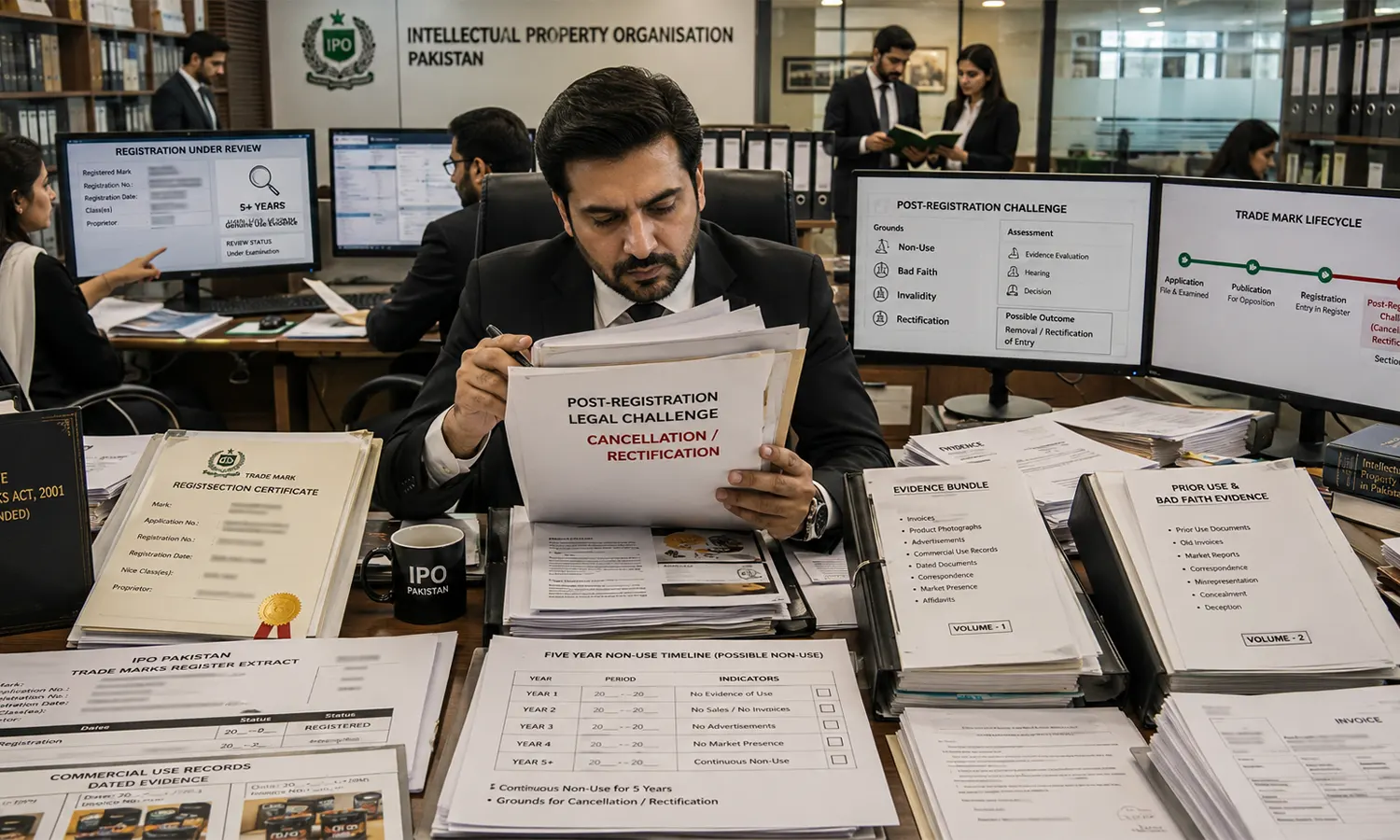
Trademark registration at IPO Pakistan is not permanent and unchallengeable. A trademark that has been examined, published without opposition, and registered on the Pakistani trademark register can still be challenged after registration through cancellation and rectification proceedings. Understanding these post-registration challenge mechanisms is essential both for businesses that need to challenge a trademark that should not have been registered, and for trademark owners who need to understand the vulnerabilities in their own registrations.
| 💡 Cancellation vs Opposition: The Key Practical Distinction |
| Opposition proceedings are PRE-registration challenges — they must be filed within two months of publication in the Trade Marks Journal, before the mark is registered. Cancellation proceedings are POST-registration challenges — they apply to marks that have already been registered. Identifying a potentially conflicting mark during the publication period and opposing it is significantly more efficient and less expensive than waiting until registration and pursuing cancellation. Monitoring IPO Pakistan’s Trade Marks Journal publications is not merely a defensive tactic — it is a commercially sensible use of available information. |
The Grounds for Cancellation: At a Glance
| Ground | Section | When It Applies | Burden of Proof | Typical Timeline |
| Non-use for 5 years | S. 52(1) | Mark registered 5+ years ago with no genuine use in Pakistan | Applicant establishes non-use prima facie; burden then shifts to owner to prove use | 12–24 months before Registrar |
| Bad faith | S. 52(2) | Registration obtained with knowledge of another party’s prior rights, without genuine commercial intent | Applicant must prove registrant’s knowledge and absence of genuine intent | 18–36+ months; often in courts |
| Invalidity — absolute grounds | S. 52(2) | Mark lacked distinctiveness and should have been refused at examination | Applicant must demonstrate the mark fails absolute grounds criteria | 12–36 months |
| Misleading or deceptive use | S. 52(1)(c) | Use of the mark by the owner has caused it to become misleading about nature, quality, or origin | Applicant must demonstrate the deceptive quality has arisen post-registration | 12–24 months |
| Fraud on registration | S. 52(2) | Registration obtained by fraudulent misrepresentation in the application | Applicant must prove the fraudulent misrepresentation made to IPO Pakistan | 24–48+ months; typically in courts |
The Three Main Grounds in Detail
Non-Use for Five Years: the Most Commonly Invoked Ground
Under Section 52(1) of the Trade Marks Ordinance 2001, a registered trademark may be revoked if, within the period of five years following the date of completion of the registration procedure, it has not been put to genuine use in Pakistan in relation to the goods or services for which it is registered, and there are no proper reasons for non-use. Similarly, a registered trademark may be revoked if such use has been suspended for an uninterrupted period of five years.
The non-use ground is practically significant for several reasons. It addresses the problem of trademark squatters and speculative registrations: parties who register trademarks not for genuine commercial use but to block competitors. A squatter who registers a brand name in Pakistan without any genuine intent to use it in commerce creates a registration that is vulnerable to cancellation after five years of non-use.
Genuine use is assessed against the standard of commercial use of the mark in the ordinary course of trade in relation to the registered goods or services. Token use — use of the mark solely for the purpose of defeating a cancellation application — does not constitute genuine use. Proper reasons for non-use (import restrictions, regulatory barriers, force majeure) may excuse non-use. Commercial decisions not to use the mark are generally not proper reasons.
Bad Faith: the Key Ground for Squatted Marks
A registration obtained in bad faith is a registration whose applicant knew, at the time of filing, that the application was improper — because the applicant knew that the mark belonged to another party, or because the applicant was registering the mark specifically to block a competitor or to extract commercial advantage from a party who has a legitimate interest in the mark.
Bad faith cancellation proceedings are most relevant in the trademark squatting context: where an opportunistic registrant has filed a trademark application for a name that belongs to another party, with knowledge of the other party’s rights and with the intention of exploiting those rights commercially. If the squatted trademark is less than five years old, the non-use ground may not yet be available, but the bad faith ground may provide an alternative basis for cancellation. Evidence of bad faith typically includes proof of the registrant’s knowledge of the other party’s prior commercial use and proof of the absence of any genuine commercial intent by the registrant.
Invalidity on Absolute Grounds: When the Mark Should Have Been Refused
A registered trademark can be challenged on the grounds that it should not have been registered in the first place because it lacks distinctiveness, is descriptive of the goods or services, consists of a generic term, or is otherwise registrable on absolute grounds. This ground is most relevant where the examiner’s decision to register the mark appears to have been in error — for example, where a purely descriptive term was registered without evidence of acquired distinctiveness.
Who Can Apply and Where
Any person may apply to cancel a registered trademark on the grounds of non-use or invalidity under the Trade Marks Ordinance 2001. The applicant does not need to have any specific commercial interest in the cancellation. However, in practice, cancellation applications are most commonly brought by parties who have a direct commercial interest — businesses whose trademark applications have been refused because of the earlier registration, businesses who are being threatened by the registered owner, or businesses who believe that a speculative registration is blocking their legitimate commercial activities.
Cancellation proceedings can be filed either at IPO Pakistan before the Registrar of Trade Marks, or before the courts. In practice, many cancellation proceedings in Pakistan are brought before the courts, particularly where the cancellation is one component of broader trademark litigation that also involves infringement claims. For standalone cancellation applications where the primary goal is to remove a blocking registration from the register, the Registrar’s jurisdiction may be more cost-effective and straightforward.
The Evidence Required
Non-Use Proceedings
In a non-use cancellation application, the initial burden of proof rests on the cancellation applicant to show that the registration has been in existence for five or more years and to make an initial case for non-use. Once this initial burden is discharged, the burden shifts to the registered owner to demonstrate genuine use of the mark in Pakistan during the relevant five-year period. Evidence of genuine use typically includes sales invoices and delivery records showing commercial transactions in Pakistan, photographs of products bearing the mark, advertising and marketing materials, and evidence of the mark’s presence in Pakistani retail or online markets.
The evidence of use must be in relation to the specific goods or services covered by the registration. Use of the mark in relation to other goods or services does not satisfy the genuine use requirement for the registered goods or services. This is particularly relevant for registrations in multiple classes — use in one class does not prevent cancellation in another class where no genuine use has occurred.
Invalidity and Bad Faith Proceedings
In invalidity proceedings based on bad faith or fraud, the applicant must provide evidence supporting the specific ground of invalidity claimed. For bad faith proceedings, this typically requires evidence that the registrant knew of the applicant’s prior rights or commercial activities at the time of filing, and evidence that the registration was filed without genuine commercial intent. Documentary evidence of the parties’ prior commercial relationship, correspondence showing the registrant’s knowledge of the applicant’s rights, and evidence of the registrant’s commercial activities (or lack thereof) are all relevant.
The Process: From Application to Decision
Step 1: File the Cancellation Application
File the cancellation application with IPO Pakistan or the relevant court, setting out the grounds of cancellation, the evidence supporting those grounds, and the relief sought. The application must specify the registration number of the challenged mark, the grounds of cancellation, and the specific relief sought — full cancellation, partial cancellation limited to specific goods or services, or rectification of the register.
Step 2: Service on the Registered Owner
After the cancellation application is filed, the registered owner is served with notice and given an opportunity to respond. The registered owner can file a response defending the registration, providing evidence of genuine use (in non-use proceedings) or contesting the grounds of invalidity (in invalidity proceedings).
Step 3: Hearing and Decision
After the parties have filed their evidence and submissions, the Registrar or court typically holds a hearing at which both parties can present their arguments. After the hearing, the Registrar or court issues a decision. If the cancellation application is granted, the registration is removed from the register. If refused, the registration remains in force.
Step 4: Appeal if Necessary
Decisions of the Registrar in cancellation proceedings can be appealed to the courts. Decisions of the courts in cancellation proceedings can be appealed through the normal appellate court structure.
| ⚠ Real-World Example: The Non-Use Cancellation of a Speculative Registration |
| A Pakistani consumer goods company had developed a distinctive brand name for a new product line and filed a trademark application at IPO Pakistan. The application was refused because an identical name was already registered in the same class by a different entity. The company searched the market for any products or services sold under the registered mark and found no evidence of any commercial activity. The registered owner appeared to have no active business presence or any products on the Pakistani market under the name. The company filed a cancellation application on the ground of non-use. The registration had been on the register for more than seven years without evidence of genuine commercial use in Pakistan. The registered owner filed a response including photographs of packaging bearing the mark and a small number of invoices. The company’s counsel challenged the evidence as insufficient — the invoices were for very small quantities, the photographs appeared to have been staged after the cancellation application was filed, and there was no evidence of any commercial distribution or retail presence. The Registrar found that the evidence was insufficient to demonstrate genuine use in the ordinary course of trade and ordered cancellation. The company subsequently filed its trademark application successfully. |
| ⚠ Real-World Example: The Bad Faith Cancellation |
| A Pakistani technology company had been using a distinctive brand name for its software product for several years, building commercial recognition and a customer base without registering the brand name as a trademark. A competitor became aware of the technology company’s brand and filed a trademark application for the same name at IPO Pakistan, in the same class as the technology company’s core software product, before the technology company did. The competitor had no prior commercial use of the name. The technology company filed a cancellation application based on bad faith. The evidence included documentation of the technology company’s commercial activities under the brand name predating the competitor’s filing, correspondence showing the competitor was aware of the technology company’s brand before filing, and evidence that the competitor had no genuine commercial use of the mark. The Registrar found that the evidence of the competitor’s knowledge of the technology company’s prior commercial use, combined with the absence of any genuine commercial use by the competitor, established bad faith. The registration was cancelled. The technology company then filed its own trademark application, which proceeded to registration. The lesson: the bad faith ground addresses exactly the scenario where a competitor registers a mark with knowledge of another party’s prior use, without any genuine commercial intent. |
Strategic Considerations: When to Pursue Cancellation
| 💡 Before Committing to Cancellation Proceedings, Consider: |
| 1. Commercial resolution first: Is the registered owner willing to assign, licence, or consent? Negotiations are typically faster and less expensive than cancellation proceedings. 2. Non-use check: If the registration has been on the register for 5+ years with no apparent commercial activity, the non-use ground is often the most straightforward basis. Check this before pursuing more complex invalidity grounds. 3. Is the registration a genuine obstacle? Not every adverse registration creates an actual commercial problem. If the owner is not active and not threatening proceedings, the urgency of cancellation may be lower than it initially appears. 4. Partial cancellation: If the registration covers multiple classes or a broad goods/services range, and only part of it conflicts with the applicant’s activities, partial cancellation may be a proportionate and less complex remedy. |
Frequently Asked Questions
Can I File a Cancellation Application in Pakistan If I Am Not Based in Pakistan?
Yes. There is no requirement that the cancellation applicant be a Pakistani business or resident. Foreign businesses and individuals can file cancellation applications in Pakistan, provided they comply with the procedural requirements. Foreign applicants typically need to engage a Pakistani trademark attorney as their representative in the proceedings.
Is There a Time Limit for Filing a Cancellation Application on Invalidity Grounds?
The Trade Marks Ordinance does not impose a fixed time limit on invalidity-based cancellation applications in the same way that it imposes the five-year period for non-use proceedings. However, delay in bringing invalidity proceedings may be taken into account by the Registrar or court, and unreasonable delay can in some circumstances affect the prospects of success. Filing cancellation proceedings promptly after becoming aware of the grounds for cancellation is advisable.
What Happens to the Trademark Registration During Cancellation Proceedings?
The registration remains on the register and in full legal effect during cancellation proceedings. Until a final order of cancellation is made, the registered owner retains the statutory rights associated with the registration. A party who brings cancellation proceedings cannot assume that the registration is invalid during the proceedings. In some cases, it may be possible to obtain an interim order preventing the registered owner from bringing infringement proceedings based on the challenged registration, but this requires a specific application for interim relief.
If a Cancellation Application Is Successful, Does the Cancellation Take Effect Retroactively?
The effect of a successful cancellation depends on the grounds and the terms of the cancellation order. A cancellation on non-use grounds typically takes effect from the date of the cancellation order, not retroactively. A cancellation on invalidity grounds, particularly bad faith, may be ordered with retroactive effect, treating the registration as having been invalid from the date of registration. The specific effect depends on the terms of the order and the relevant provisions of the Trade Marks Ordinance.
Can a Trademark Owner Take Steps to Protect Against Cancellation?
Yes. The most effective protection against non-use cancellation is genuine commercial use of the registered mark in Pakistan in relation to the registered goods or services, documented with contemporary records including sales invoices, marketing materials, and distribution records. Maintaining such records as an ongoing operational practice, rather than assembling them retrospectively when a cancellation application is threatened, provides the most reliable evidence of genuine use. Against invalidity-based cancellation, the best protection is a registration obtained legitimately and in good faith for a mark that the registrant has a genuine commercial interest in using.
Final Thoughts
Cancellation and rectification proceedings are commercially important tools in Pakistan’s trademark system. For businesses blocked by an existing registration — whether through a dormant speculative registration or a bad faith registration obtained by a competitor — cancellation proceedings provide the mechanism for clearing that obstacle from the register.
For trademark owners, understanding the grounds for cancellation and the evidence required to defend against a cancellation application is an essential part of trademark portfolio management. Genuine use of registered marks in Pakistan, documented contemporaneously, is the most effective protection against non-use cancellation. Registrations obtained in good faith for marks that are genuinely used in commerce are significantly more durable against challenge than speculative or dormant registrations.
| Get Started with TM |
| TM assists Pakistani businesses with cancellation and rectification proceedings at IPO Pakistan and in the courts — from initial assessment of cancellation grounds through to evidence assembly, filing, and representation at hearings. Visit: tm.com.pk/contact Email: contact@tm.com.pk Phone: 03-111-456-456 |