
| September 3, 2026 | Desk: Brand & IP Law | 17 min read · 4012 words |
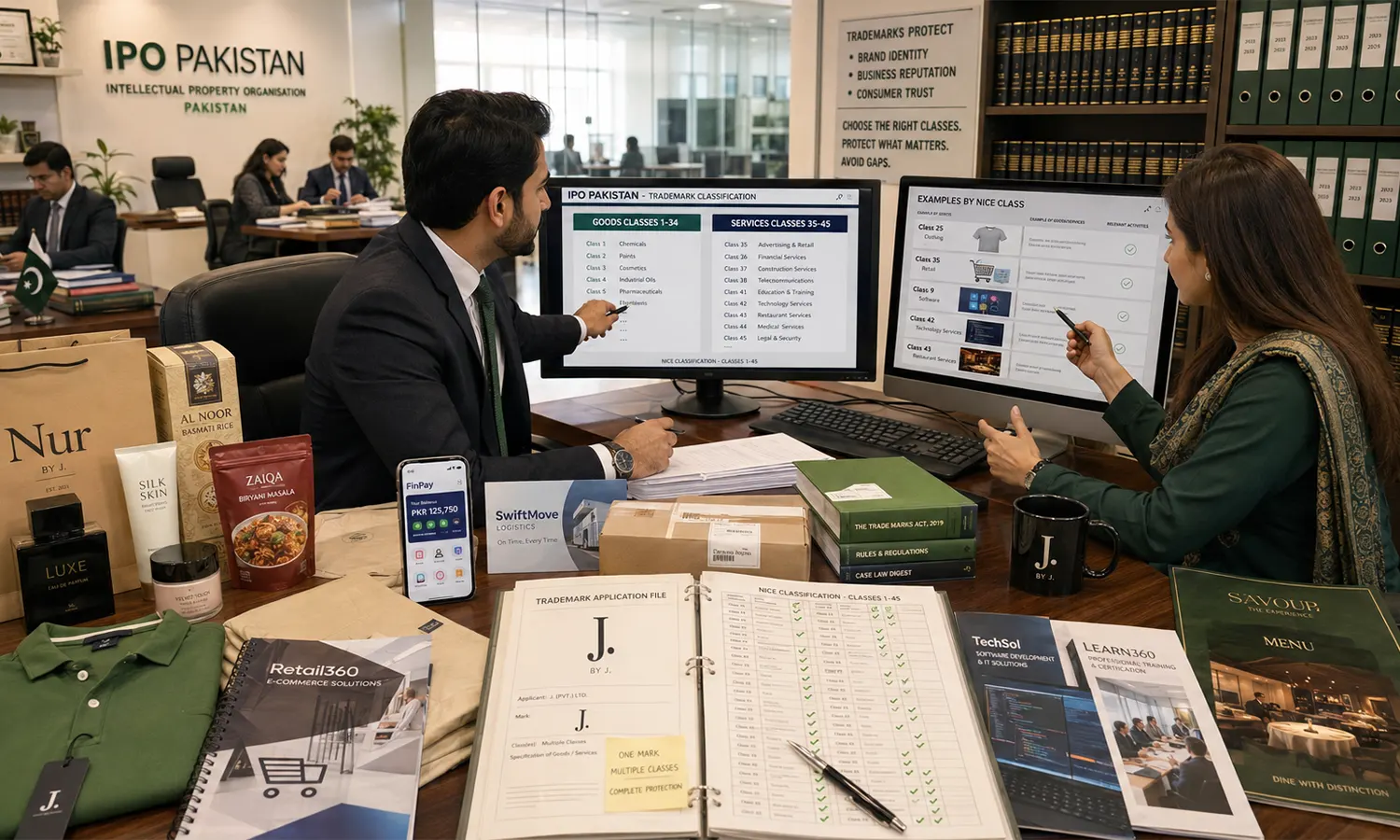
Every trademark application filed at IPO Pakistan must specify the class or classes of goods and services for which trademark protection is sought. This classification system — the Nice Classification, established under the Nice Agreement of 1957 — is used by trademark offices in virtually every country in the world, including Pakistan.
The Nice Classification divides all commercial goods and services into 45 classes: 34 classes for goods and 11 classes for services. The class or classes selected in a trademark application determine the scope of the trademark’s protection. A trademark registered in Class 25 for clothing protects the brand name on clothing products. It does not protect the same brand name on food products in Class 30, pharmaceutical products in Class 5, or retail services in Class 35. Each class is a distinct registration, and the protection afforded by any single registration is limited to the commercial activities covered by that class.
Choosing the wrong class — or failing to choose all the relevant classes — results in a registration that provides narrower protection than the business believes it has, with gaps in exactly the commercial areas where the business operates.
| 💡 How to Read the Quick-Reference Tables |
| The tables below list all 45 Nice Classes with the relevant Pakistani business types for each. Classes highlighted in green are the most commercially significant for Pakistani businesses across the industries covered in this publication. For any business, identify every commercial activity — goods sold AND services provided — and find each in the appropriate class. Most businesses need more than one class. The class is determined by what the goods or services ARE, not by how they are made, how they are sold, or what the business calls itself. |
Classes 1–34: Goods Classes
| Class | Category | Relevant Pakistani Businesses |
| 1 | Industrial chemicals, fertilisers | Fertiliser brands, agricultural chemical companies, industrial chemical suppliers |
| 2 | Paints, varnishes, inks, dyes | Paint manufacturers, printing ink brands, colourant suppliers |
| 3 | Cosmetics, personal care, toiletries | Beauty brands, shampoo/conditioner, skin care, perfume, personal hygiene products |
| 4 | Lubricants, fuels, oils, candles | Engine oil brands, lubricant manufacturers, fuel product brands |
| 5 | Pharmaceuticals, pesticides, supplements | Pharmaceutical brands, veterinary medicines, pesticide/herbicide brands, health supplements |
| 6 | Common metals, metal hardware | Steel product brands, metal hardware manufacturers, construction material companies |
| 7 | Machines, motors, engines | Agricultural machinery, industrial equipment, motor/engine brands, power tools |
| 8 | Hand tools, cutlery, razors | Cutlery brands, kitchen implements, hand tools, barber scissors and razors |
| 9 | Technology, software, electronics, apps | Tech companies, software developers, app brands, electronics brands, gaming, digital content |
| 10 | Medical and surgical instruments | Medical device brands, dental equipment, therapeutic device manufacturers |
| 11 | Lighting, heating, cooking, water supply | AC/heating brands, cooking appliance brands, water treatment equipment, lighting |
| 12 | Vehicles and vehicle parts | Vehicle assemblers, tyre brands, vehicle parts manufacturers, automotive accessories |
| 13 | Firearms, explosives | Licensed arms and ammunition manufacturers and traders |
| 14 | Jewellery, precious metals, watches | Jewellery brands, gold/silver manufacturers, gemstone brands, watch brands |
| 15 | Musical instruments | Musical instrument brands and manufacturers |
| 16 | Printed matter, stationery, publications | Newspaper publishers, book publishers, magazine brands, stationery brands |
| 17 | Rubber, plastics, insulating materials | Rubber goods manufacturers, plastic material suppliers |
| 18 | Leather goods, bags, luggage | Leather goods brands, handbag and wallet brands, luggage brands |
| 19 | Non-metal building materials | Ceramic tile brands, cement product brands, non-metal construction materials |
| 20 | Furniture and furnishings | Furniture brands, home furnishing brands, office furniture manufacturers |
| 21 | Household utensils, cookware, glassware | Kitchen utensil brands, cookware brands, household goods manufacturers |
| 22 | Ropes, nets, sacks, raw textile materials | Rope and cordage manufacturers, industrial sack and bag manufacturers |
| 23 | Yarns and threads | Yarn manufacturers, thread brands supplying the textile industry |
| 24 | Textiles, fabric, household linen | Pakistani textile exporters, fabric brands, household linen brands, curtain brands |
| 25 | Clothing, footwear, headgear | Fashion brands, bridal wear, ready-to-wear, sportswear, footwear brands, apparel exporters |
| 26 | Lace, embroidery, buttons, sewing accessories | Embroidery supply brands, garment accessory manufacturers |
| 27 | Carpets, rugs, floor coverings | Pakistani carpet brands, rug manufacturers, floor covering brands |
| 28 | Sporting goods, games, toys | Sports equipment brands, toy manufacturers, gaming equipment brands |
| 29 | Processed foods — meat, dairy, preserved | Dairy brands, processed food brands, packaged meat, preserved fruit and vegetable brands |
| 30 | Grain-based foods, rice, tea, spices | Rice brands (incl. Basmati), flour brands, tea brands, spice brands, confectionery brands |
| 31 | Agricultural produce, seeds, live animals | Seed companies, fresh produce exporters, agricultural goods brands, livestock brands |
| 32 | Non-alcoholic beverages, juices, water | Juice brands, mineral water brands, carbonated drink brands, beverage companies |
| 33 | Alcoholic beverages (except beer) | Relevant for export-oriented brands and international brand protection |
| 34 | Tobacco products | Tobacco product brands |
Classes highlighted in green are the most commercially significant for Pakistani businesses across the industries covered in this publication. Classes 3, 5, 9, 14, 18, 24, 25, 29, and 30 are the goods classes most frequently relevant to Pakistani brands.
Classes 35–45: Services Classes
| Class | Category | Relevant Pakistani Businesses |
| 35 | Advertising, business, retail services | Marketing agencies, e-commerce platforms, retail chains, business consultancies, import/export |
| 36 | Financial, insurance, real estate services | Banks, insurance companies, fintech brands, microfinance, real estate agencies, investment firms |
| 37 | Construction, repair, installation services | Construction companies, renovation services, vehicle repair workshops, appliance repair |
| 38 | Telecommunications, broadcasting, streaming | TV channels, radio stations, telecom companies, internet service providers, streaming platforms |
| 39 | Transport, logistics, travel services | Courier brands, freight forwarders, logistics companies, travel agencies, passenger transport |
| 40 | Custom manufacturing and material processing | Tailoring services, printing services, fabric dyeing, custom garment production |
| 41 | Education, entertainment, cultural services | Schools, coaching centres, sports academies, event management, media production, news organisations |
| 42 | Technology services, software development | Software companies, IT service providers, cloud computing brands, tech research organisations |
| 43 | Food service, accommodation services | Restaurant brands, hotel brands, catering companies, cafes, guest houses, resorts |
| 44 | Medical, veterinary, beauty services | Hospitals, clinics, diagnostic labs, pharmacy chains, beauty salons, spa brands, grooming services |
| 45 | Legal, security, personal services | Law firms, security companies, personal concierge and social services |
Classes 35, 36, 38, 39, 41, 42, 43, and 44 are the services classes most frequently relevant to Pakistani businesses. Note that Class 35 (business and retail services) and Class 41 (education and entertainment) are each broader than their names suggest — see the detailed notes below.
The Classes That Confuse Pakistani Businesses Most
Class 9: Technology, Software, and Electronics
Class 9 is one of the most commercially significant classes for modern Pakistani businesses and one of the most commonly overlooked. It covers all technology products: computers, smartphones, tablets, software, mobile applications, video games, electronic publications, and related technology goods. Any Pakistani technology company, software developer, app developer, fintech brand, or digital content brand needs Class 9. Crucially, if a business has a physical product brand (Class 25, 30, or any other goods class) and also operates a branded app through which customers access or order that product, Class 9 is also needed for the app.
Class 35: Business Services and Retail — Broader Than It Appears
Class 35 is one of the most commonly misunderstood classes in Pakistani practice. It covers advertising services, marketing services, retail trading services, online marketplace services, business consulting, import and export agency services, business management, and office administration. A marketing agency needs Class 35. An e-commerce platform needs Class 35. A retail clothing chain needs Class 35 alongside Class 25 for the clothing itself. A business consultancy needs Class 35. Import and export trading services need Class 35. The class is broad and often relevant to businesses that do not immediately recognise their core activity as a Class 35 service.
Class 41: Education, Entertainment, and More
Class 41 covers educational services (schools, coaching centres, training academies), entertainment services (media production, events, theatre), sporting and cultural activities (sports academies, fitness centres, cultural festivals), and news journalism services. A coaching centre and a sports academy and a television channel and an event management company all sit in Class 41, alongside each other. The breadth of Class 41 means that businesses in very different industries share the same class — making thorough trademark searches in Class 41 essential before naming a school, academy, entertainment company, or media brand.
Class 43 for Restaurants, Not Class 30 for Food
A common mistake for Pakistani restaurant and food service brands is filing in Class 30, where food products sit, instead of Class 43, where food service (restaurant, catering, hospitality) sits. A restaurant selling biryani is providing a food service in Class 43. A company manufacturing and selling packaged biryani paste is selling a food product in Class 30. A brand that does both needs both classes. Getting this distinction right is practically important because many Pakistani food brands operate both as food product manufacturers and as food service providers.
Class 42 for Technology Services, Not Class 9 for Technology Products
Software that is sold as a product (a mobile app, a downloaded programme, a packaged software product) is in Class 9. Software development services, IT consulting services, cloud computing services, and technology design services are in Class 42. A software company that develops apps for clients is a Class 42 service provider. If it also sells its own branded app to end users, it needs Class 9 as well. The distinction between the service of developing technology and the product of technology is the key distinction between Class 42 and Class 9.
How to Identify the Right Classes for a Specific Pakistani Business
| 💡 The Two-Step Class Selection Method |
| Step 1: List every commercial activity of the business — every type of good sold, every service provided, every planned product extension or service expansion. Step 2: For each commercial activity, ask: is this a good (a physical or digital product sold to the customer) or a service (an activity performed for the customer)? Then identify which class the good or service falls in using the tables above and the WIPO Nice Classification alphabetical list. File in every class that covers a current or planned commercial activity. The incremental cost of adding a class is modest. The commercial cost of a protection gap is not. |
The Most Common Classification Errors
Filing in the Goods Class Without Also Filing in the Relevant Services Class
A business that both produces goods and provides services typically needs registrations in both the goods class and the services class. A clothing brand that registers in Class 25 for clothing but not in Class 35 for retail trading services has not protected its retail brand identity. A restaurant brand that registers in Class 43 for restaurant services but not in Class 30 for any branded food products it sells has a protection gap in the product extension of its brand.
Filing in the Services Class Without Also Filing in the Relevant Goods Class
Conversely, a service brand that develops a product line without registering in the appropriate goods class creates a gap in product protection. A salon brand that registers in Class 44 for salon services but not in Class 3 for the personal care products it sells under its brand has left the product brand unprotected. A software services company that develops and sells its own branded software product without registering in Class 9 has left the software product unprotected.
Putting Goods or Services in the Wrong Class
Some goods and services descriptions fall in unexpected classes that are not immediately obvious. Restaurant services are in Class 43, not Class 30. Retail trading services are in Class 35, not in the class of the goods sold through the retail outlet. IT services are in Class 42, while software products are in Class 9. Educational services are in Class 41, while textbooks are in Class 16. Getting the class right requires careful reference to the Nice Classification system, not reliance on general assumptions.
Filing in Too Few Classes to Cover the Full Commercial Scope
Many Pakistani trademark applicants file in the minimum number of classes — usually one — to minimise the filing cost, without considering whether the single class covers all the commercial activities that the trademark needs to protect. Filing in all relevant classes from the outset, while incurring a higher initial cost, is consistently more cost-effective than trying to add coverage later after a protection gap has been identified and exploited.
Frequently Asked Questions
If I Register a Trademark in Class 25 for Clothing, Does It Also Protect the Brand in Other Classes?
No. A trademark registered in Class 25 for clothing protects the brand name only in relation to clothing and related goods within Class 25. It does not protect the same brand name in relation to goods or services in other classes. A clothing brand that expands into restaurant services, food products, or beauty products needs separate registrations in Classes 43, 30, and 3 respectively. The territorial scope of a registration covers all of Pakistan, but the subject matter scope is limited to the class and the goods or services description within that class.
How Do I Know If My Goods or Services Fall in More Than One Class?
Most businesses have commercial activities that span more than one Nice Class. The best approach is to list all the commercial activities of the business — what goods are sold, what services are provided, what related activities are planned — and then map each activity to the appropriate class using the tables in this guide and, where needed, the WIPO Nice Classification alphabetical list available through WIPO’s Brand Database or through a trademark professional.
Is the Nice Classification the Same in Pakistan as in Other Countries?
Yes. The Nice Classification is an international system used by trademark offices in the vast majority of countries worldwide, including Pakistan. The class numbers and class descriptions are standardised internationally, which means that a trademark registered in Class 25 in Pakistan for clothing covers the same category of goods as a trademark registered in Class 25 in the UK, EU, UAE, or anywhere else that uses the Nice Classification. This standardisation is one of the features that facilitates international trademark filing through the Madrid Protocol.
What Happens If I File My Trademark in the Wrong Class?
If a trademark is registered in the wrong class — for example, if clothing is incorrectly registered in Class 24 for textile fabrics rather than Class 25 for clothing — the registration protects the brand name in relation to the wrong category of goods. A competitor selling the same type of goods under the same name may not be infringing the registration, because the registration is in a class that does not cover the competitor’s goods. Incorrect class selection is a serious error that can render a trademark registration commercially ineffective. Using a trademark professional to advise on class selection is the most reliable way to avoid this error.
Can I File My Trademark Application in All 45 Classes?
Technically, there is no restriction on filing in all 45 classes. However, applying in classes that are not relevant to the business’s actual or intended commercial activities is inadvisable. IPO Pakistan may question whether the applicant has a genuine intention to use the mark in all designated classes. More practically, a registration in a class that is not used commercially is vulnerable to cancellation for non-use after five years. Filing in all relevant classes is good practice. Filing in all 45 classes regardless of commercial relevance is wasteful and creates legal vulnerability.
Final Thoughts
The Nice Classification system is the foundation of how trademark protection is structured. Understanding which class or classes cover a specific Pakistani business’s commercial activities is not merely a technical filing requirement — it determines the scope and commercial effectiveness of the trademark registration.
The most reliable approach to class selection is to take a comprehensive view of the business’s commercial activities — what is sold, what services are provided, what is planned — and map each activity to the appropriate class. Filing in all relevant classes from the outset is consistently more cost-effective than discovering gaps after a conflict arises or a competitor exploits an unprotected category.
| Get Started with TM |
| TM helps Pakistani businesses identify the correct Nice Classes for their trademark applications, draft accurate goods and services descriptions, and file trademark applications at IPO Pakistan with appropriate class coverage for the full scope of the business’s commercial activities. Visit: tm.com.pk/contact Email: contact@tm.com.pk Phone: 03-111-456-456 |