
| August 13, 2026 | Desk: Brand & IP Law | 14 min read · 3103 words |
On August 12, 2026, Pakistan secured one of its most significant intellectual property victories in international trade. The Federal Court of Australia dismissed an appeal filed by India’s Agricultural and Processed Food Products Export Development Authority — APEDA — rejecting India’s bid to register the word Basmati as a certification trademark exclusively for Indian rice in the Australian market. The court not only dismissed the appeal but ordered APEDA to pay the legal costs of the opposing party, a procedural sanction that signals the court’s view that the appeal lacked sufficient merit to succeed.
The ruling is not merely a legal footnote. It has direct commercial consequences for Pakistani Basmati exporters selling into Australia, strategic consequences for Pakistan’s broader international campaign to protect its Basmati commercial interests, and broader implications for how the world handles geographical indications for agricultural products that originate from regions now divided by international borders.
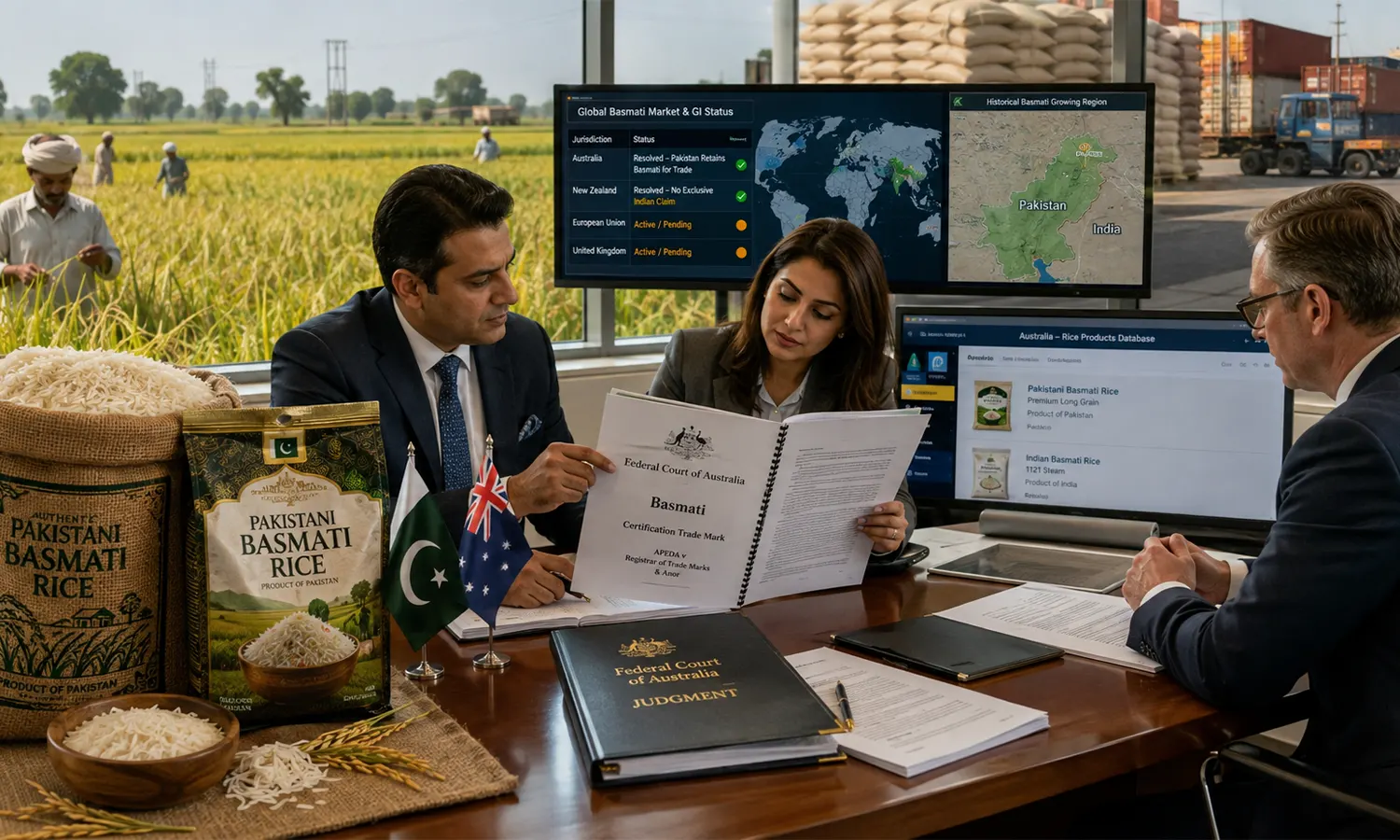
Basmati’s Global Battlefield at a Glance
| Market | Current Status | Key Details | Result |
| Australia | Pakistan WINS | Federal Court dismisses APEDA appeal (Aug 2026). Pakistani exporters free to use Basmati name. APEDA ordered to pay costs. | ✔ Resolved — Pakistan |
| European Union | PENDING | India filed EU GI application (2018). Pakistan filed opposition (2020) and rival application (2023). EU outcome unresolved. Most commercially significant market. | ⏳ Active |
| United Kingdom | PENDING | Post-Brexit UK GI proceedings active. Large British Pakistani diaspora market at stake. | ⏳ Active |
| New Zealand | Pakistan holds | Earlier proceedings found against APEDA’s exclusive claim. Similar outcome to Australia. | ✔ Holds — Pakistan |
| Pakistan (domestic) | Pakistan GI registered | Basmati registered under Geographical Indications Act 2020 (January 2021). Domestic GI basis established. | ✔ Secured |
| India (domestic) | India GI registered | India granted domestic GI tag for Basmati (2016) under its Geographical Indications Act. Does not affect other jurisdictions. | ✔ India’s domestic |
What the Australian Court Actually Decided
To understand the significance of the ruling, it is important to be precise about what APEDA was attempting to do and what the Australian court actually decided.
APEDA applied to register the word Basmati as a certification trademark in Australia. A certification trademark is used not by a single business to identify its own goods, but by an organisation to certify that goods from various producers meet specific standards — in this case, that the rice meets quality and origin standards defined by APEDA for Indian Basmati rice. If granted, APEDA’s certification trademark would have allowed it to certify Indian Basmati with the Basmati name in Australia while potentially challenging the use of the same name by Pakistani exporters who did not hold APEDA certification.
A delegate of the Australian Registrar of Trade Marks rejected the application on December 22, 2022. The grounds for rejection were fundamental: the word Basmati could not distinguish rice certified by APEDA from Basmati rice legitimately produced and marketed by other traders, including Pakistani traders. The Australian trademark system found that Basmati is not a word that one national authority can monopolise, because it legitimately describes rice from more than one producing country.
APEDA challenged this rejection before the Federal Court of Australia. The Federal Court has now dismissed that challenge, upholding the registrar’s original findings, including the express recognition that Basmati rice is also grown in Pakistan and that Pakistani traders have an equally valid claim to use the term.
| 💡 The Core Legal Finding |
| The Australian court found that the word “Basmati” cannot function as a certification trademark for exclusively Indian rice, because Basmati legitimately describes rice from a historically recognised growing region that spans both Pakistan and India. No single national authority — Indian or Pakistani — can claim an exclusive right over the word Basmati to the exclusion of producers and exporters from the other country who have an equally legitimate right to its use. This finding aligns with Pakistan’s consistently maintained position across all international forums and establishes a clear precedent in Australian trademark law. |
The Commercial Stakes in Australia
Australia is not Pakistan’s largest Basmati export market — the Gulf states, Europe, and North America absorb the largest volumes. But it is commercially significant. Pakistani rice exports to Australia were valued at approximately USD 21.58 million in 2024, making Pakistan the second-largest rice exporter to Australia by shipment count, accounting for around 21 percent of total shipments, behind only India.
For this market, the Australian court’s decision removes a specific and commercially consequential threat. If APEDA had succeeded in registering Basmati as its certification trademark, Pakistani exporters selling Basmati rice in Australia without APEDA certification would have faced potential trademark infringement claims. Retailers and distributors sourcing Pakistani Basmati for the Australian market would have faced legal uncertainty about whether they were carrying a trademark-infringing product. The court’s decision eliminates this threat entirely for the Australian market.
What the decision does not yet deliver is positive GI protection for Pakistani Basmati in Australia. The Australian ruling is a defensive victory: it prevents India from obtaining exclusive rights, but it does not create positive certification mark or GI protection for Pakistani Basmati. Pursuing that positive protection, building on the legal foundation the court has now established, is the next strategic step for Pakistan in the Australian market.
The Larger Battlefield: Understanding the Global Basmati GI Dispute
The European Union: the Most Commercially Significant and Still Unresolved Front
The European Union is the highest-value front in the Basmati GI dispute. The EU is Pakistan’s largest overseas Basmati market by value, and the EU’s geographical indication system is among the most commercially powerful GI frameworks in the world. Products that achieve Protected Geographical Indication status in the EU benefit from legal protection of the geographic name across all twenty-seven EU member states and from the commercial credibility that EU GI status confers in premium retail markets.
India filed an application for Protected Geographical Indication status for Basmati rice in the EU in July 2018, defining the eligible Basmati growing region in terms that excluded Pakistan. Pakistan’s Rice Exporters Association filed an opposition with EU authorities in December 2020, and Pakistan subsequently registered Basmati under its Geographical Indications Act 2020 in January 2021. In 2023, Pakistan filed its own rival GI application with the EU, seeking recognition of Basmati as a geographical indication linked to a cross-border growing region covering both countries.
The EU proceedings remain unresolved. The question before the EU is genuinely novel: how should the EU’s GI framework handle a product with a real cross-border growing region when the two producing countries are also geopolitical rivals with conflicting national GI claims? The EU framework was designed primarily for single-jurisdiction regional products — Champagne, Parma ham, Darjeeling tea. Its application to cross-border agricultural products from non-EU countries, where the two producing countries have difficult diplomatic relations, is unprecedented territory.
Adding a further layer of complexity, Pakistan’s 2023 EU application included growing regions in Pakistan-administered Kashmir, a move India regards as politically sensitive given the territorial dispute. This geopolitical dimension has introduced considerations into the GI proceedings that go beyond the agricultural and IP questions the framework was designed to resolve. If India achieves exclusive EU GI protection for Basmati, Pakistani Basmati exports to Europe could face significant commercial barriers — the Basmati premium that Pakistani exporters command in European markets depends entirely on the ability to market the rice as Basmati.
The United Kingdom and New Zealand
Following Brexit, the UK established its own GI framework, and the Basmati dispute has extended into UK proceedings separately from the EU case. The UK market is commercially significant for Pakistani Basmati, driven in large part by the large British Pakistani community. In New Zealand, similar proceedings earlier found against APEDA’s exclusive claim — an outcome consistent with the Australian decision.
Why Basmati Is Uniquely Complex as a GI Dispute
The Basmati case is among the most legally complex geographical indication disputes in international trade law because it involves a product that genuinely originates from a trans-border growing region now split across two sovereign states with difficult bilateral relations.
Basmati rice has been cultivated in the Indo-Gangetic Plain for centuries. The specific soil conditions, water sources from Himalayan rivers, and climate patterns that give Basmati its distinctive characteristics — the elongated grain, the aromatic quality, the specific cooking properties — are associated with a geographic zone that exists across what is now the border between India and Pakistan. This geographic reality predates the Partition of British India in 1947 by many generations.
When the British Indian agricultural lands that produced Basmati were divided in 1947, the Basmati-growing zone was divided between the two new nations. Farmers and seed stocks on both sides of the new border continued to grow what they had always grown. The rice they grew was still Basmati. The geographic, agricultural, and cultural heritage of the product was shared by the two new nations whether the political situation acknowledged this or not.
The GI framework that most international jurisdictions have developed is designed primarily to protect products from specific, single-jurisdiction geographic areas. It provides no ready answer when the producing region crosses a national border, particularly when the two countries have conflicting national GI claims and difficult diplomatic relations. The Basmati case exposes this gap in the international GI framework more starkly than almost any other disputed agricultural product.
| 💡 The Legal Principle the Australian Court Established |
| The doctrine endorsed by both the Australian Registrar and the Federal Court is the most legally coherent approach to this problem: Basmati is a term that legitimately describes rice from the historical Basmati-growing region spanning both Pakistan and India. No single national authority can claim an exclusive trademark or certification mark over the word Basmati to the exclusion of producers from the other country who have an equally legitimate right to use it. This principle, now established in Australian common-law jurisdiction, provides directly applicable precedent for the EU and UK proceedings where Pakistan is making the same argument. |
Pakistan’s Domestic GI Framework and International Strategy
Pakistan enacted the Geographical Indications Act in 2020, establishing the domestic legal framework needed to register and protect Pakistani products’ geographical indications. Under this framework, Pakistan registered Basmati rice as a geographical indication in January 2021. This domestic registration is the legal foundation for Pakistan’s international GI strategy, establishing that Pakistan recognises Basmati as a Pakistani geographical indication associated with specific growing regions in Punjab and other Basmati-producing areas of the country.
The Ministry of Commerce has taken an active role in co-ordinating Pakistan’s international Basmati protection efforts across Australian, EU, and UK proceedings. The consistent position maintained by Pakistan across all forums is that Basmati is a geographical indication linked to a historically recognised growing region spanning areas of both Pakistan and India, and that no single national authority can claim an exclusive right over the word Basmati to the exclusion of producers and exporters from the other country.
The Australian Federal Court’s decision endorses this position in unambiguous terms. Each international decision in Pakistan’s favour strengthens the consistency and credibility of Pakistan’s position in the forums where the dispute remains active, particularly in the EU. Commerce Minister Jam Kamal Khan congratulated the Ministry of Commerce team on the outcome and praised the efforts of government agencies and other stakeholders involved in the case.
What the Basmati Dispute Reveals About Pakistan’s Broader GI Needs
The Basmati case is the most prominent example of a broader challenge facing Pakistan’s internationally traded agricultural and artisanal products. Pakistan’s distinctive agricultural outputs — Sindhri and Chaunsa mangoes, Kinnow citrus, Multani pottery, Peshawari chappal, Chilghoza pine nuts, Hunza apricots — all have geographic associations and quality characteristics that could, in principle, be protected through geographical indication frameworks in export markets.
The Basmati case has demonstrated, at considerable effort and expense, both the value of an active international GI protection strategy and the cost of pursuing that strategy reactively, in response to a competing country’s proactive claims, rather than proactively, by establishing Pakistani GI claims in key markets before competing interests do.
Pakistan’s Geographical Indications Act 2020 provides the domestic legal foundation for this work. Building on that foundation to pursue positive GI protection for Pakistan’s most commercially significant agricultural products in key export markets — before competing national or commercial interests establish prior claims in those markets — is the strategic task that the Basmati case illustrates the urgency of.
What Comes Next
The Australian victory is significant, but the Basmati dispute is far from fully resolved. The EU and UK proceedings remain the most commercially consequential fronts and remain active. In the EU, the competing GI applications from India and Pakistan are both pending. The EU’s approach to this genuinely novel problem — a trans-border GI from two non-EU countries with competing claims — will have implications extending beyond Basmati to the broader question of how the EU GI framework handles cross-border agricultural heritage products.
Pakistan should use the momentum of the Australian decision to intensify its engagement in the EU and UK proceedings, presenting the Australian Federal Court’s findings as part of the consistent international legal consensus that Basmati cannot be monopolised by one national authority. A resolution that provides positive recognition of Pakistani Basmati alongside Indian Basmati in the EU and UK markets would be commercially transformative for Pakistan’s rice export sector.
At the same time, Pakistan’s agricultural and trade authorities should use the Basmati case as a model for building proactive GI protection strategies for other Pakistani agricultural products in key export markets, before competing countries or commercial interests establish prior claims in those markets. The lesson of the Basmati dispute is that reactive IP protection is more expensive, slower, and less certain than proactive IP protection pursued before competing claims are established.
The Australian Federal Court has ruled. The Basmati name belongs to the Basmati-growing region. Pakistan is part of that region. Pakistani exporters have an equally valid right to use the name. This is the right outcome. Building on it effectively in the EU, UK, and beyond is the work that comes next.
| About TM and Geographical Indications |
| TM advises Pakistani agricultural businesses, producer associations, and exporters on geographical indication protection in Pakistan and international markets. For guidance on GI strategy, trademark registration, or Basmati-related intellectual property questions, contact us. Visit: tm.com.pk/contact Email: contact@tm.com.pk Phone: 03-111-456-456 |