
| August 11, 2026 | Desk: Brand & IP Law | 17 min read · 3911 words |
Pakistan’s wedding industry is one of the largest, most emotionally significant, and most commercially active sectors in the country’s consumer economy. The average Pakistani wedding involves multiple ceremonies across several days, a guest list that can run into the hundreds or thousands, and expenditure that represents a significant financial commitment for most families. Collectively, Pakistan’s wedding market generates hundreds of billions of rupees annually across venues, catering, bridal wear, decoration, photography, videography, makeup, jewellery, music, and event management.
This commercial scale has produced a sophisticated brand landscape. Bridal wear designers with national and international recognition. Wedding photography studios whose work defines the aesthetic benchmark in their markets. Event management companies that have built reputations for flawless execution at scale. Catering brands associated with specific quality standards. Wedding venues that have become aspirational destinations.
Yet the wedding industry is also one of Pakistan’s most imitation-prone commercial sectors. The emotional stakes of a wedding create intense client interest in specific brands and specific professionals, which creates powerful commercial incentives for imitators who use similar names, copy portfolio imagery, or otherwise trade on established wedding brand reputations to attract clients who believe they are booking the established service.
Nice Classes for Wedding Industry Brands
| Class | What It Covers in the Wedding Industry | File When |
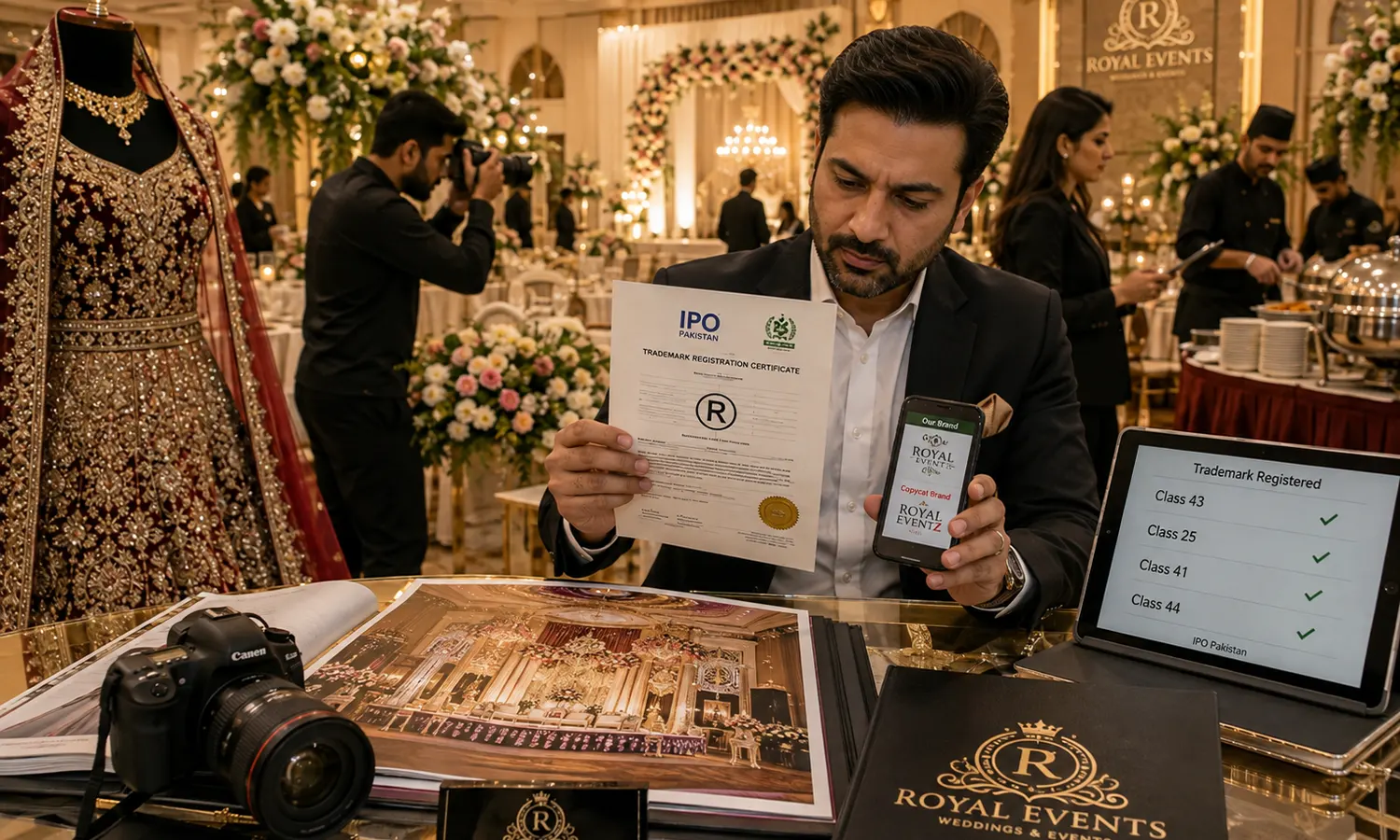
| Class 43 | Wedding catering, banquet services, wedding venue services, event food and beverage, reception halls | Always for caterers, venues, and banquet hall brands |
| Class 25 | Bridal wear, wedding dresses, lehngas, sherwani, wedding accessories, wedding footwear | Always for bridal fashion designers and wedding clothing brands |
| Class 41 | Wedding photography, videography, event management, wedding entertainment, wedding planning services | Always for photographers, event managers, and entertainment brands |
| Class 44 | Bridal makeup, mehndi services, bridal hair and beauty treatments, bridal grooming services | Bridal makeup artists, mehndi studios, bridal beauty brands |
| Class 35 | Wedding vendor marketplaces, online wedding booking platforms, wedding directory services | Digital wedding platforms and wedding media brands |
| Class 20 | Wedding decoration items, furniture for events, centrepieces, floral decoration goods | Wedding decorators selling physical decoration products |
| 💡 The Core Wedding Industry Trademark Triad |
| Most wedding businesses will need at least one of three classes — many will need all three: Class 43 — Catering and Venue Services: caterers, banquet halls, farmhouse wedding venues, reception brands. Class 25 — Bridal Wear and Clothing: designers, manufacturers, bridal accessories, wedding attire brands. Class 41 — Photography, Event Management, and Entertainment: photographers, event planners, wedding entertainment, videography studios. Add Class 44 for bridal makeup and mehndi services. File in all relevant classes simultaneously — the cost of adding a class is small relative to the protection gap of omitting it. |
Bridal Fashion: Pakistan’s Most Internationally Recognised Wedding IP
Pakistani bridal fashion has achieved a degree of international recognition that is unusual for any Pakistani industry. Pakistani bridal designers are recognised and sought out by South Asian brides in markets across the world. The brand names of Pakistani bridal designers — HSY, Nomi Ansari, Fahad Hussayn, Sana Safinaz, and others — are commercial assets with genuine international commercial significance.
For Pakistani bridal fashion brands, the trademark strategy must reflect this international dimension. A bridal designer whose collections are sold in London, Dubai, Toronto, and New York, as well as in Karachi, Lahore, and Islamabad, needs trademark protection that covers those international markets, not only Pakistan. The core Pakistani trademark registration in Class 25 provides domestic protection. The Madrid Protocol provides the most cost-effective mechanism for extending that protection to international markets where the brand has or aspires to have commercial presence.
The imitation risk for Pakistani bridal fashion brands is multi-layered. At the domestic level, clothing manufacturers produce near-identical copies of branded bridal collections and sell them under the same or a confusingly similar brand name. At the international level, diaspora-market sellers may use a Pakistani designer’s brand name or confusingly similar names on products that are not genuine products of that designer. Trademark registration in Class 25 in Pakistan and in key international markets provides the legal foundation for challenging both forms of imitation.
Wedding Photography: Brand, Portfolio, and Copyright
Wedding photographers and videography studios have two distinct but related intellectual property interests: their brand name and visual identity as a commercial identifier, and their creative work product as copyright-protected creative content.
The brand name of a photography studio, used commercially to identify the studio’s services and attract clients, is a trademark in Class 41. The photographs and videos produced by the studio are copyright-protected creative works that belong to the studio from the moment of creation, without registration.
A specific and documented problem for wedding photography studios in Pakistan is portfolio theft. A competing studio downloads images from an established studio’s website or social media and uses them as their own portfolio to attract clients. This is a copyright infringement — the images belong to the original studio from the moment of creation. For wedding photography studios, the combination of a trademark registration in Class 41 for the studio brand and clear copyright documentation — including watermarking, metadata, and publication records that establish ownership — provides the most comprehensive protection for both commercial dimensions of the studio’s intellectual property.
Event Management Brands: Building and Protecting an Operational Reputation
Wedding event management companies build their commercial reputations on operational reliability, creative execution, and vendor relationships. The brand equity of an event management company is fundamentally a promise of consistent performance delivery that clients are paying a premium to access. This makes event management brands particularly vulnerable to a specific form of brand damage: a copycat company that uses the same or a confusingly similar brand name to attract clients who believe they are booking the established company, then delivers a lower quality of execution attributed to the genuine brand.
Event management brand protection follows the same pattern as other service brands: trademark registration in Class 41 for event management services is the foundational requirement. For event management companies that also provide catering or venue arrangements, Class 43 is relevant alongside Class 41. A well-documented client contract that makes clear which company the client has contracted with, includes the company’s registered trademark details, and specifies the service standards the client is entitled to expect, reduces the risk of confusion between the genuine company and a copycat.
| ⚠ Real-World Example: The Bridal Designer and the Counterfeit Collection |
| A Pakistani bridal fashion house with a registered trademark in Class 25 discovered that a clothing manufacturer in Lahore’s bridal market was selling near-identical replicas of the designer’s signature embroidery patterns and silhouette styles under a name that was a phonetic variation of the designer’s brand name. The counterfeit collection was priced significantly below the genuine brand and was being sold through retail outlets that stocked both genuine and counterfeit products. The designer’s trademark registration in Class 25 was the basis for civil trademark infringement proceedings seeking an injunction against the use of the confusingly similar name, damages for the commercial harm caused by the infringing sales, and delivery up or destruction of the infringing stock. The proceedings were supported by evidence of the registered trademark, the substantial similarity between the brand names, and consumer testimony from clients who had purchased the counterfeit product believing it was the genuine brand. The outcome included an injunction, a damages award, and destruction of the remaining infringing stock. The designer simultaneously filed Madrid Protocol applications designating the UK, UAE, and Canada, where the same imitation pattern was beginning to appear in diaspora markets. |
| ⚠ Real-World Example: The Wedding Photographer and the Portfolio Thief |
| A Karachi-based wedding photography studio with an established brand and a distinctive visual style discovered that a new photography business had launched under a confusingly similar name and was using images from the established studio’s portfolio — downloaded from the studio’s social media — as its own portfolio to attract clients. The studio held a registered trademark in Class 41 for photography services. The trademark registration was the basis for a trademark infringement complaint regarding the confusingly similar name. The use of the studio’s images as the new business’s portfolio was a separate copyright infringement, addressed through a cease and desist letter asserting copyright ownership of the images. The photography competitor received both challenges simultaneously: a trademark-based challenge to its brand name and a copyright-based challenge to its use of the appropriated portfolio images. The combination made the new business’s position untenable — it could neither continue to operate under the confusingly similar name nor continue to use the images it had appropriated. The new business rebranded under a clearly distinct name and removed the appropriated images from its portfolio within thirty days. The lesson: wedding photographers have two distinct intellectual property tools — trademark protection for the studio brand and copyright protection for the creative work. Using both simultaneously is more effective than relying on either alone. |
Step-by-Step: Building Trademark Protection for Pakistani Wedding Industry Brands
Step 1: Identify All Brand Elements and Commercial Activities
Map every commercial brand element: the business name, any sub-brands, the visual logo, and any distinctive stylistic identifiers associated with the brand. Map these against the commercial activities of the business — services provided, products sold, digital platforms operated — to identify all the Nice Classes in which trademark protection is needed.
Step 2: File in Classes 43, 25, and 41 as the Core Wedding Industry Triad
Most wedding businesses will need at least one of these three classes, and many will need more than one. Class 43 for catering and venue services. Class 25 for bridal wear and wedding clothing. Class 41 for photography, event management, and entertainment. Identify which classes cover the specific business’s primary commercial activities and file in all of them simultaneously.
Step 3: Add Class 44 for Bridal Beauty and Makeup Services
Bridal makeup artists, mehndi studios, and bridal beauty brands providing beauty services in a wedding context need Class 44. If the beauty service operates alongside event management or entertainment services, Class 44 needs to be filed alongside Class 41.
Step 4: File Internationally Before Entering Diaspora Markets
For Pakistani bridal designers and wedding service brands with international commercial activity — selling through London boutiques, exhibiting at UK bridal fairs, marketing to UAE-based Pakistani brides — the Madrid Protocol is the most cost-effective mechanism for extending trademark protection to those markets. File the international designations before or simultaneously with the first commercial activity in each market.
Step 5: Document Copyright in Creative Work
For wedding photographers, videographers, and bridal designers, systematically document copyright ownership of creative work: watermark images, maintain metadata, retain original files, and keep records of first publication dates for all significant creative content. This documentation strengthens copyright enforcement if portfolio theft or design copying is identified. Copyright protection arises automatically in Pakistan for original creative works but is most reliably enforced when clear ownership documentation exists.
Step 6: Use Contracts to Clarify Brand Identity with Clients
Ensure that all client contracts clearly identify the company by its registered trademark name, include the trademark registration number, and specify the service standards the client is contracting for. In a sector where copycat operations attract clients by trading on established brands, a clear contract that makes the genuine company’s identity unambiguous provides both a commercial protection for the client and a documentary record that supports enforcement if a copycat misrepresents its identity.
Common Mistakes Pakistani Wedding Industry Brands Make with Trademarks
Not Registering the Brand Before the Peak Season Marketing Begins
Wedding industry brands typically invest heavily in marketing before peak wedding seasons. This is also when copycat operations have the most incentive to appropriate a well-promoted brand identity. Registering the trademark before the peak season marketing begins, not during or after it, ensures that the legal protection is in place when the brand exposure is highest.
Protecting the Designer Name but Not the Collection Names
Bridal fashion brands often have both a designer name and collection names for specific seasonal lines. The designer name is typically registered. The collection names, which may develop independent commercial recognition, are often not registered. A collection name that develops strong market recognition is worth protecting as a separate trademark registration alongside the designer’s name.
Assuming Copyright in Portfolio Images Prevents Portfolio Theft
Copyright in portfolio images provides a legal basis for challenging unauthorised reproduction and use of those images. It does not prevent portfolio theft from occurring, and enforcing copyright after the fact requires establishing ownership and documenting the infringement. Active portfolio management — watermarking, metadata, monitored publication — combined with trademark registration for the studio brand provides the most comprehensive deterrent and enforcement foundation.
Not Addressing International Markets Until After Market Entry
Pakistani bridal designers and wedding brands that enter diaspora markets in the UK, UAE, or North America without trademark protection in those markets are creating exactly the squatting and imitation opportunities in those markets that unprotected domestic brands create at home. File before market entry, not after.
Frequently Asked Questions
Does a Bridal Designer Need Separate Trademark Protection for Each Collection?
Not necessarily for each collection, but collection names that develop independent commercial recognition and that the designer intends to use across multiple seasons should be considered for separate registration. A one-off collection name for a single seasonal line may not warrant separate registration. A collection name that has become a recurring brand element and has developed its own market recognition is worth protecting.
Can a Mehndi Artist Register Their Own Name as a Trademark?
Yes. A personal name can be registered as a trademark in Class 44 or Class 41 if it is used commercially to identify the person’s services and has become a brand identifier for that person’s mehndi or bridal service. A mehndi artist whose name is actively sought out by clients, who is mentioned specifically in recommendations and booking requests, is using their name in a trademark sense that supports registration in the relevant commercial classes.
Is Wedding Catering Covered by Class 43 or Class 41?
Wedding catering services — providing food and beverage services at wedding events — are covered by Class 43, which includes services for providing food and drink and catering services. Class 41 covers event organisation and entertainment, which is the class for the event management dimension of a wedding. A business that provides both wedding catering and event management needs both Class 43 and Class 41. A business that only provides food and beverage catering without event management services needs Class 43.
How Does Trademark Registration Help Against a Photographer Who Copies My Style?
Trademark registration protects the brand name and visual identity used to identify the studio in commerce. It does not protect photographic style, composition approach, or creative aesthetic directly. However, if a competing photographer uses the same or a confusingly similar brand name alongside a similar aesthetic, creating confusion about whether the competing studio is the established studio, the trademark registration provides the basis for challenging the brand name confusion even where the style similarity alone would not be actionable.
What Happens to Wedding Venue Brand Rights If the Venue Is Sold or Leased to New Operators?
The trademark rights in a wedding venue brand belong to the registered trademark owner. If the venue is sold, the trademark rights must be formally assigned to the new owner through a trademark assignment recorded at IPO Pakistan. If the venue is leased to a new operator, the lease arrangement should include provisions about the use of the venue’s brand name during the lease term and after it ends. A new operator who uses an established venue brand without a trademark licence or assignment is using a registered trademark without authorisation, which constitutes trademark infringement.
Final Thoughts
Pakistan’s wedding industry is one of the most commercially and emotionally significant sectors in the country’s consumer economy. The brands built within this sector — by bridal designers, photographers, event managers, caterers, and specialist service providers — represent commercial equity that is the product of years of creative work, operational excellence, and reputation building.
Class 43 for catering and venue services. Class 25 for bridal wear. Class 41 for photography, event management, and entertainment. Class 44 for bridal beauty and makeup. File before the peak season marketing begins. File internationally before entering diaspora markets. Document copyright in creative work. Use contracts that make brand identity clear.
The wedding industry’s combination of high emotional stakes, strong brand loyalty, and significant per-event commercial value makes it one of Pakistan’s most brand-dependent commercial sectors. The trademark registration that protects a wedding business’s brand identity is one of the most commercially valuable investments a wedding business owner can make.
| Get Started with TM |
| TM helps Pakistani wedding industry businesses — bridal designers, photographers, event managers, caterers, venues, and specialist service providers — register and protect their trademarks at IPO Pakistan and internationally. Visit: tm.com.pk/contact Email: contact@tm.com.pk Phone: 03-111-456-456 |